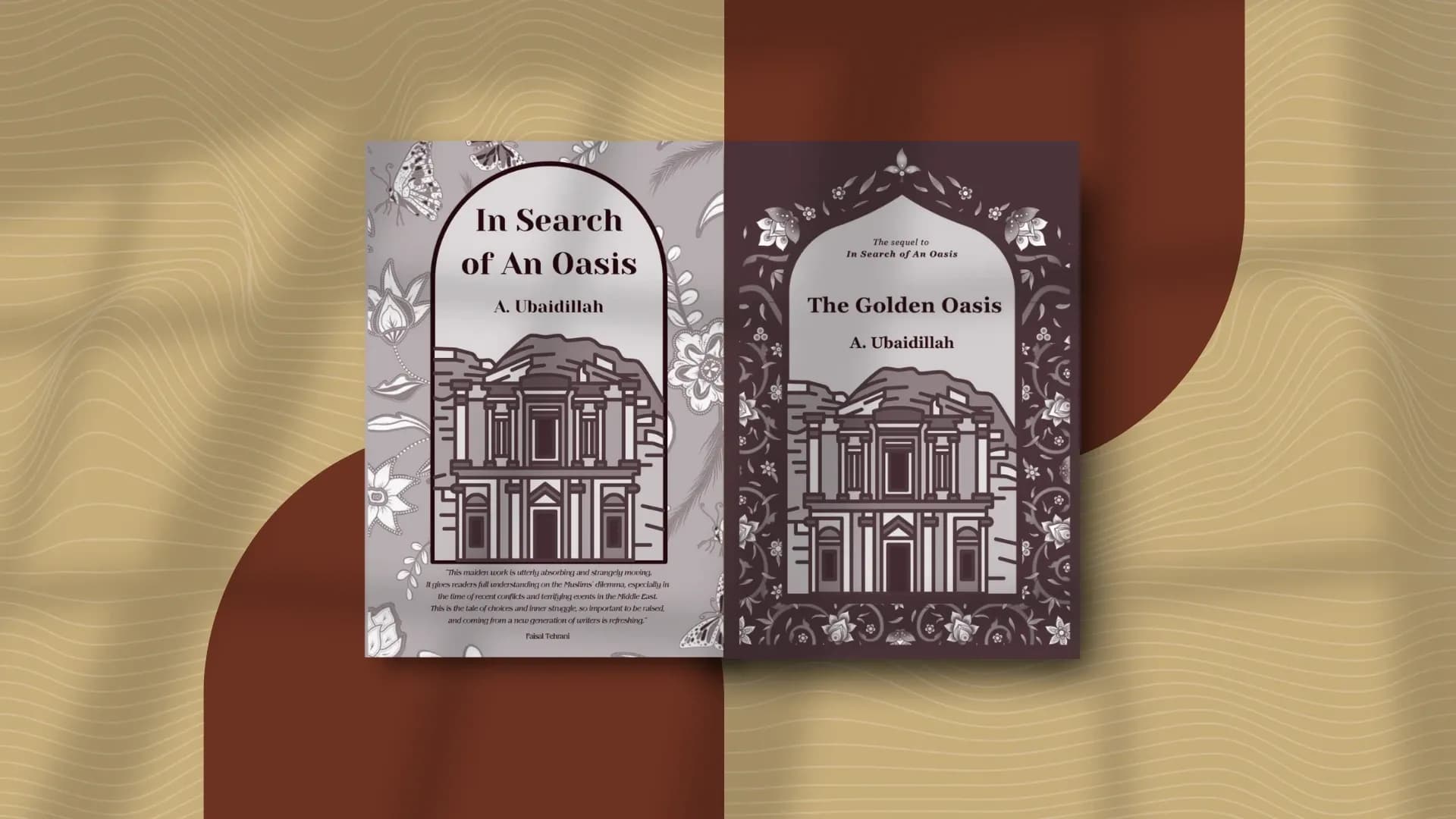
A quick trip to the library might reveal a lingering gap on the shelves: where is the contemporary Singaporean Muslim voice in written literature? While our national literature scene may be thriving, fictional stories by local authors that document the Muslim community’s experiences in English seem to be few and far between. To explore this, I sat down with Ahmad Ubaidillah, author of the Oasis Duology — In Search of an Oasis (2024) and The Golden Oasis (2025) — to find out more about his processes of documenting the modern Singaporean Muslim experience through the lens of fiction, and his vision for building a more robust local literary canon.
For the uninitiated, the Oasis duology weaves together the perspectives of Iskandar and Indra, two Singaporean cousins whose separate journeys through Jordan serve as a backdrop for a shared quest for redemption. Ubaidillah, who is a researcher by profession, uses fiction to interrogate the practice and understanding of religion in ways that a research paper cannot, i.e. the often messy anxieties surrounding the practice of faith. The duology, as I came to find from our chat, was originally a singular manuscript. “I was advised to split the novel,” he shared. “When you’re a debuting novelist, people will not be inclined to read a very long book, unless you’re [already established like] George R. R. Martin.”
“In literature, it's like a moral laboratory. You can write a character, but in a way, the characters are the ones doing it.”
For Ubaidillah, writing is a space where he can experiment with the complexities of human nature without his own voice being tethered to his characters. In this space, he then becomes a spectator to his own work – allowing the characters to navigate their own spiritual and social dilemmas in a way that feels authentic. “It came to a point where I realised that the characters came to life on their own,” he reflected. When asked about his characters, he observed that it was more difficult to write about Indra, in fear of making him appear too unlikeable. He pointed to stories from Greek mythology as a prime example: stories we still gravitate toward today, even though they are filled with unlikeable figures. He said, “I think there’s a reason for that. [...] Deep down, we are able to identify [with these stories] because we are all messy creatures. We are all grey to a certain extent.”
Reading the duology, what had struck me most was this: most novels I encounter opt for a temporally ambiguous timeline, but Ubaidillah’s work chose the jarring proximity of the Covid-19 pandemic – seemingly forcing a confrontation with a reality that many had only just begun to process. To me, seeing the effects of the pandemic mentioned truly situated the story’s timeline in the contemporary.
“I started [the duology], if I remember correctly, during COVID itself. But I had been mulling over the idea for an extended period of time.”
This might have been influenced by the context that Ubaidillah wrote his novel in. He recounted how the pandemic mandated students who were studying overseas to return home and serve a 14-day quarantine when the COVID-19 situation seemed to aggravate. This meant he himself had to return from Jordan, where he was studying then. “It was a month straight where we had to stay at home.” When asked how the lockdown experience affected his writing processes (other than having more time to write), Ubaidillah seemed to have taken it positively, even stating how the quarantine and Circuit Breaker became a writing retreat of sorts for him. “My writing habit was to write from tengah malam (the middle of the night) to subuh (fajr prayers). [...] I wrote, I slept, and so on. I was in a bubble.” However, things changed when he started working since he would not be able to sustain the routine. After a two-to-three month hiatus in writing, he started the momentum again by writing at various cafes over the weekends, or during dinner. “I had to regulate and arrange my schedule to be more productive. I had the luxury of time [to write for long stretches] during lockdown. But when you are writing for short spells – like you go to the cafe for one hour or less – it really forced me to focus harder [and] be more economic with my time.”
Funnily enough, he said, “I used to like writing in the bus […] I feel like my creative juice would increase when I'm in the bus. I would sit in a double-decker and I would take a corner seat. When the views are changing, it just puts me in the zone, so I would get ideas that I would write in my phone.” Much of In Search of an Oasis was written on the bus, witnessed by the winding roads of Khatib to Jalan Kayu to Greenwich.
Other than it being his dream to be a novelist, he cited two main reasons for his writing endeavour. He laments that he has not encountered any novel that truly revolves around the religious experiences of today’s youth, especially in relation to radicalism and religious humanism – in particular, the ways in which one internalises religious teachings, values, and principles in accordance with Islamic fundamentals that promote peace and harmony.
Ubaidillah also acknowledged the "forefathers" of the local Malay literary world – giants like Suratman Markasan, Mohamed Latiff Mohamed, and Isa Kamari – who have long explored capturing the Malay/Muslim experience. However, he had to consider how to continue this tradition in his own way. For him, that meant carving out a space for the Singaporean Muslim narrative specifically through English-language literature. This aligns with a broader sentiment in the creative community – recently echoed by Ammar Mustafa on the RIMA podcast – that practitioners must be 'creative in carving out their own niches' to keep the tradition alive.
“I feel we are part of that wider trend of consumers who do not consume Malay literature. Maybe we consume it in the classroom, but we don’t consume it organically.”
It is ultimately a supply-and-demand thing, he noted. Local publishers now have a particular focus on children’s books – or kidlit– and the number of local children’s book’s authors and illustrators has also been said to have quadrupled1. Ubaidillah shared that parents and schools are now saying that they want Malay children’s books to teach the students, but there has not been the same demand for adult novels in Malay. “That was a point raised by a publisher. Kalau kita publish pun, siapa akan baca? (Even if we publish, who is going to read?) Who will read a seventy-thousand word Malay novel by a Singaporean?”
Additionally, whoever said that a writer’s work is done once the last line is written could never be more wrong. In fact, as Ubaidillah found, that was only the beginning. Being a novelist in today’s age means that one has to be as much a strategist as they are a writer, engineering the visibility of their work from publishing decisions through to the promotional stage.
Increasing visibility during the promotional phase would mean that a novelist would have to ‘put themselves out there’. “That is one thing that people often don’t mention that writers must do,” he mused. “But it’s a matter of doing justice to your work.” He did acknowledge that it took a bit of getting used to, but he ultimately concluded that that there was nothing to lose when one puts themselves out there. “I think I have taken advice to not be too shy, and I’ve reaped a lot of rewards from it. When you have public events, you meet readers who would share with you like ‘Oh, I read your work’ and you can’t do that if you don’t go out and meet people.”
In an era where physical book fairs and launches are occasional highlights rather than daily fixtures, Ubaidillah has strategically tapped into the power of social media. However, for him, this is less about marketing and more a gesture of appreciation toward his audience. By replying to every tag, comment, and review, he transforms the solitary act of reading into a shared dialogue. This creates a vibrant ecosystem where the boundary between author and audience thins, fostering a community that feels personally invested in the journey of the Oasis duology. “It’s like a constant book club,” I reflected during our conversation, noting how his readers do not just consume the work, but actively interpret and interact with him as they read.
Ubaidillah's journey offers a blueprint for the future of the local written literary Islamic Creative Arts scene. His success suggests that what may be missing in Singaporean Muslim literature may not only be due to a lack of stories, but perhaps a need for more expansive avenues to tell them. By bridging the distance between the lack of stories and creative self-expression, he has carved out a niche that feels both unique to the Singaporean Muslim community but also broadly resonant. “I do hope to continue writing - and I definitely want to publish another novel in one or two years,” he said. “But I feel that I'm at a crossroads of what I want to write about; and in what language I want to write it in.” Whatever direction his future work takes, there is reason to be optimistic that contemporary Muslim experiences in Singapore can gain greater visibility and narrative centrality in mainstream culture. After all, Ubaidillah has already charted the way forward.
Nur Izzatie Adnan is currently a Research Analyst at the Centre of Research on Islamic and Malay Affairs (RIMA). She completed her undergraduate studies in Sociology at Nanyang Technological University, where she was able to cultivate her love for unpacking and diving deep into different cultural phenomena.