Beyond Recipes: The Cultural Odyssey of Singaporean Malay Cuisine | Karyawan
Beyond Recipes: The Cultural Odyssey of Singaporean Malay Cuisine
Abdillah Ammar
22 Apr 2025
9 min read
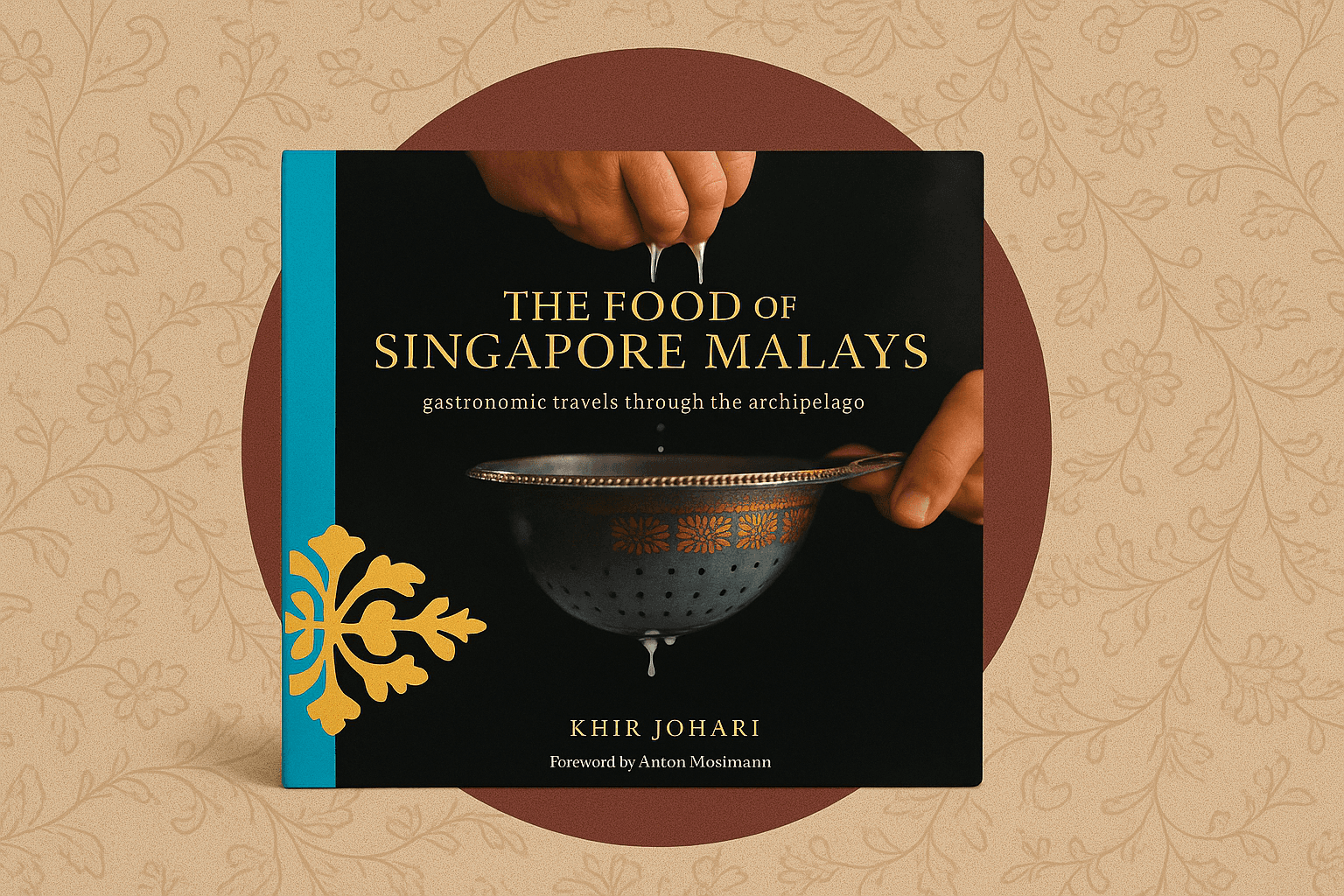
Khir Johari’s The Food of Singapore Malays: Gastronomic Travels Through the Archipelago goes beyond being just a traditional cookbook, providing a deep exploration of Malay cuisine as a vital cultural artifact. This significant work investigates Malay food in Singapore through its social, cultural, and historical aspects, presenting it as a vibrant entity shaped by centuries of transformation. Drawing on over a decade of careful research and engaging storytelling, Johari creates a narrative that links the culinary traditions of Singapore Malays to their wider Nusantara heritage. Given the comprehensive nature of Johari’s work, this review will focus on the key areas of his book.
Singapore’s Malay Kitchen: A Cultural Crossroads
Singapore’s Malay cuisine showcases its rich history and deep ties to regional neighbours. Dishes like Beef Rendang, Nasi Lemak, and Nasi Ambeng are cherished by many in Singapore, but they are also staples in Malaysia and Indonesia, exemplifying the shared culinary heritage of the Malay world. This vibrant cuisine is characterised by bold flavours, aromatic spices, and the use of regional ingredients. One notable dish is botok-botok, a fish steak marinated with ingredients such as kerisik (toasted grated coconut) and curry powder, then wrapped in layers of foliage such as papaya and cassava leaves, before being enclosed in a larger banana leaf for cooking.
Johari emphasises that Malay food in Singapore is not a monolithic entity, but a diverse culinary tradition shaped by the community’s heterogeneous origins. The Malays in Singapore comprise of various regional ethnic groups, including the Javanese, Baweanese, and Minangkabau, each contributing unique dishes that enrich Malay cuisine. The Javanese brought dishes such as Nasi Rawon and Nasi Jenganan, while the Baweanese introduced Sayor Chelok. The Minangkabau are known for , a popular dish of steamed white rice served with an array of side dishes, which has become a staple in Singapore. Among the many establishments, is arguably one of the most well-known.
To truly appreciate Malay food, one must engage with the intricate layers of Malay identity itself. While Singapore’s conception of “Malay” is often understood as an umbrella term encompassing various indigenous regional ethnic communities, these communities carry long-standing culinary traditions that continue to shape and define Malay cuisine today.
Indigenous Ingredients and Techniques
One of the most fascinating aspects of Johari's work is his exploration of indigenous ingredients and traditional cooking techniques, particularly the longstanding foraging practices of coastal Malays, including those who once inhabited Temasek. He highlights how foraging, or ramu, has been integral to Malay culinary traditions, reflecting a deep connection to nature and resourcefulness in food gathering. The term ramuan, which refers to collected ingredients, originates from ramu, a word often translated into English as "ingredients."
He also sheds light on traditional preservation techniques, many of which are at risk of being lost in the modern era. Among these methods are fermentation and salting, which have played a crucial role in Malay culinary traditions. One notable example is belachan, a fermented shrimp paste that serves as a key ingredient in many Malay dishes. Similar variations of this ingredient exist across Southeast Asia, such as nam prik ta-daeng in Thailand.
Belachan is also essential in sambal belachan, a highly popular condiment in the Malay world. Beyond its culinary significance, belachan reflects the traditional food preservation practices of the Malays, as it can last for up to a year. Given that the Malays are historically a seafaring people who often spent extended periods at sea, it was common for them to carry belachan while traveling to various ports across the Nusantara. This ingredient was not only valued within Malay communities but also sought after by others. Yemeni Arab merchants, for instance, were known to bring back goods from the Malay Archipelago, including keropok (fish crackers) and belachan, highlighting its broader cultural and economic significance.
Additionally, we have tools common in Malay households such as the antan-and-lesong (Stone mortar and pestle) pair, or the batu giling (grinding stone) – used for grounding and pounding ingredients into a paste.
Symbolism, Community and Tradition
Johari's work goes beyond recipes and ingredients to explore the profound cultural significance of food in Malay society. Communal gatherings play an essential role in Malay culture, taking place for various reasons, including feasts for showing gratitude to God, sending off relatives for their hajj (pilgrimage), and solemn gatherings for the deceased. These gatherings fall under the umbrella term kenduri, which often involves communal dining and the recitation of prayers, invoking God’s blessings in the kenduri.
Certain dishes are typically reserved for communal events, including Pulut Kunyit (also known as Pulut Kuning) and Nasi Ambeng. Pulut Kunyit is traditionally served during kenduri kesyukuran (feasts for showing gratitude to God) to celebrate milestones or significant life events. Johari describes Nasi Ambeng as a concept originating from Javanese communities. Traditionally, it consists of a large platter with white rice in the centre, surrounded by seven or nine Javanese dishes. In Singapore, while dishes were traditionally placed directly on the rice mound, modern commercialised versions adopt the Nasi Tumpeng style, arranging dishes around the rice. A portion is usually left uneaten and taken home by each family to attain baraka (blessings) from God.
What is Truly a Malay Dish?
Malay cuisine has undergone significant evolution, shaped by historical influences ranging from the era of Sri Vijaya to the arrival of Islam and the post-colonial period. Over time, most – if not all – Malay dishes have been influenced by both regional and global cultures, reflecting a dynamic process of adaptation and integration.
Take Mee Rebus and Mee Siam, for example. Johari describes Mee Rebus as having been created in Rumah Jawa in Singapore by the Javanese diaspora. The dish primarily consists of yellow noodles served in a thick gravy made from krill and fermented soybeans, enhanced with sweet potatoes. Similarly, Mee Siam has evolved significantly, particularly in Kampong Gelam. This dish is prepared with rice vermicelli, fermented soybeans (taucho), dried shrimp, and Chinese chives. Interestingly, it was also described by Sylvia Tan, a Chinese Peranakan culinary expert, as an "originally Malay dish"2.
One may ask: What makes dishes like these Malay if the ingredients used do not originate from the region? As Johari explains, the process of adapting and incorporating ‘foreign’ ingredients into local cuisine is a defining characteristic of Malay culinary tradition. These influences have enriched Malay cuisine, creating new dishes that reflect continuity and change.
It is also important to note that this exchange of culinary influences goes both ways. This is particularly evident in the emergence of the Peranakan communities, who are descendants of intermarriages between locals and migrants. The Peranakan Chinese, for example, incorporated Malay ingredients like coconut and palm sugar into their cooking. A notable example is Babi Pongteh, a braised pork dish that uses palm sugar, a staple in Malay cuisine. Another dish that illustrates the blending of Chinese and Malay culinary traditions is Pork Sambal, which shows how Malay cooking techniques were adapted to meet Chinese preferences.
General Reflections on the Legacy of Malay Food
In navigating the legacy of Malay food, a commitment to both preservation and adaptation is paramount. As Johari explained,
“There is nothing wrong in taking creative liberties, but if it diverges too far and becomes as good as a wholly new dish in its own right, then call it something else.”
In light of the popularity of fusion food – there is a need to acknowledge the essence of a dish and maintain it, even in the face of innovation. Elsewhere in Singapore, the kunafa – a traditional dessert from the Middle East, originating from the Levant region, particularly Palestine – is currently a hot topic of discussion. Kunafa is more than just a dessert – it symbolises cultural identity and resilience. For Palestinians, the “Kunafa Nabulsia” holds a particular significance as a tangible reminder of their heritage and identity, in light of the ongoing displacement and struggles for self-determination. Many believe food should remain true to its origins, emphasising authenticity to preserve cultural memory. Therefore, preserving culinary traditions such as kunafa becomes vital for safeguarding a part of the cultural identity. The commercialisation of its viral adaptations in local bazaars has been criticised, with some questioning their intent3. Maintaining culinary traditions is about preserving flavours and safeguarding cultural heritage, particularly for communities whose people have been threatened by conflict and displacement.
There is also the problem of cultural amnesia among the Malays, as more dishes are getting forgotten as time passes by. Johari notes how there are even Malay vendors misnaming otak-otak as ‘otah’ – something you would not expect the people who came up with the dish to do. However, there are also efforts by others who fiercely resist the innovative market forces, as can be seen by the “NO RED BEANS” posters outside a Chendol stall in Geylang, since original Chendol recipes which have originated from Java do not contain red beans.
Part of dismantling cultural amnesia also involves examining blurred boundaries between Malay and overlapping cuisines, such as the Chinese Peranakan. For example, traditional Malay desserts such as Putri Salat and Onde-Onde are now usually understood as ‘Nyonya Kueh.’ Regionally, there have also been nationalist spats on social media platforms on whether Nasi Lemak is from Malaysia or Indonesia. These arguments should not be reduced merely to people being overly sensitive. People identify strongly with the cultures they are in – and food is one anchor in which they remain strongly grounded to their cultures.
Overall, Khir Johari has created an amazing work on Singaporean Malay Gastronomy. Two questions remained throughout the book: What makes one a Malay, and what does being a Singaporean Malay mean? He constantly invokes introspection, taking readers on a journey through the Archipelago, reminding us to appreciate our food and critically examine how Malay cuisine came to be today.
Abdillah Ammar is currently an undergraduate at the National University of Singapore, majoring in Political Science and minoring in Malay Studies. He is also taking a part-time degree in Islamic Sciences, majoring in Hadith at Al-Madinah International University. His research interests include Sufism in the Malay World, comparative politics, and the role of customs in the Islamic legal tradition.
About the Author
Abdillah Ammar is currently an undergraduate in the National University of Singapore double majoring in Political Science & minoring in Malay Studies. He is also taking a part-time degree majoring in Hadith at Al-Madinah International University. His research interests include Sufi metaphysics, comparative politics and the role of customs in the Islamic legal tradition.