Mangroves: Shelter, Shield, and Social Space | Karyawan
Mangroves: Shelter, Shield, and Social Space
Sabrina Binte Hardy
30 Jul 2025
8 min read
In the 19th century, mangrove forests made up a substantial part of Singapore’s landscape, covering 13% of the country’s total land area. Today, mangroves are only found in small patches in Sungei Buloh Wetland Reserve, Berlayer Creek, Labrador Park Nature Reserve, Pasir Ris Park, and Chek Jawa. Its total land area now covers only about 0.5% of Singapore’s land1 after two centuries of colonial resource extraction followed by extensive land reclamation and development in the post-independence era. For example, the creation of the Kranji, Pandan, and Seletar reservoirs to meet the drinking water and sanitation needs of a growing society significantly reduced mangrove areas in the northern parts of Singapore2.
Why should we even care about mangroves? Although some may dismiss these terrains as unsightly, swampy, and muddy pieces of land, mangrove forests are more than meets the eye. These ecosystems hold a rich history in Singapore and continue to provide social value today, as a unique space for wildlife enthusiasts (such as birdwatchers) and photography lovers to connect with the natural world. Crucially, mangroves are also unsung heroes of the environment.
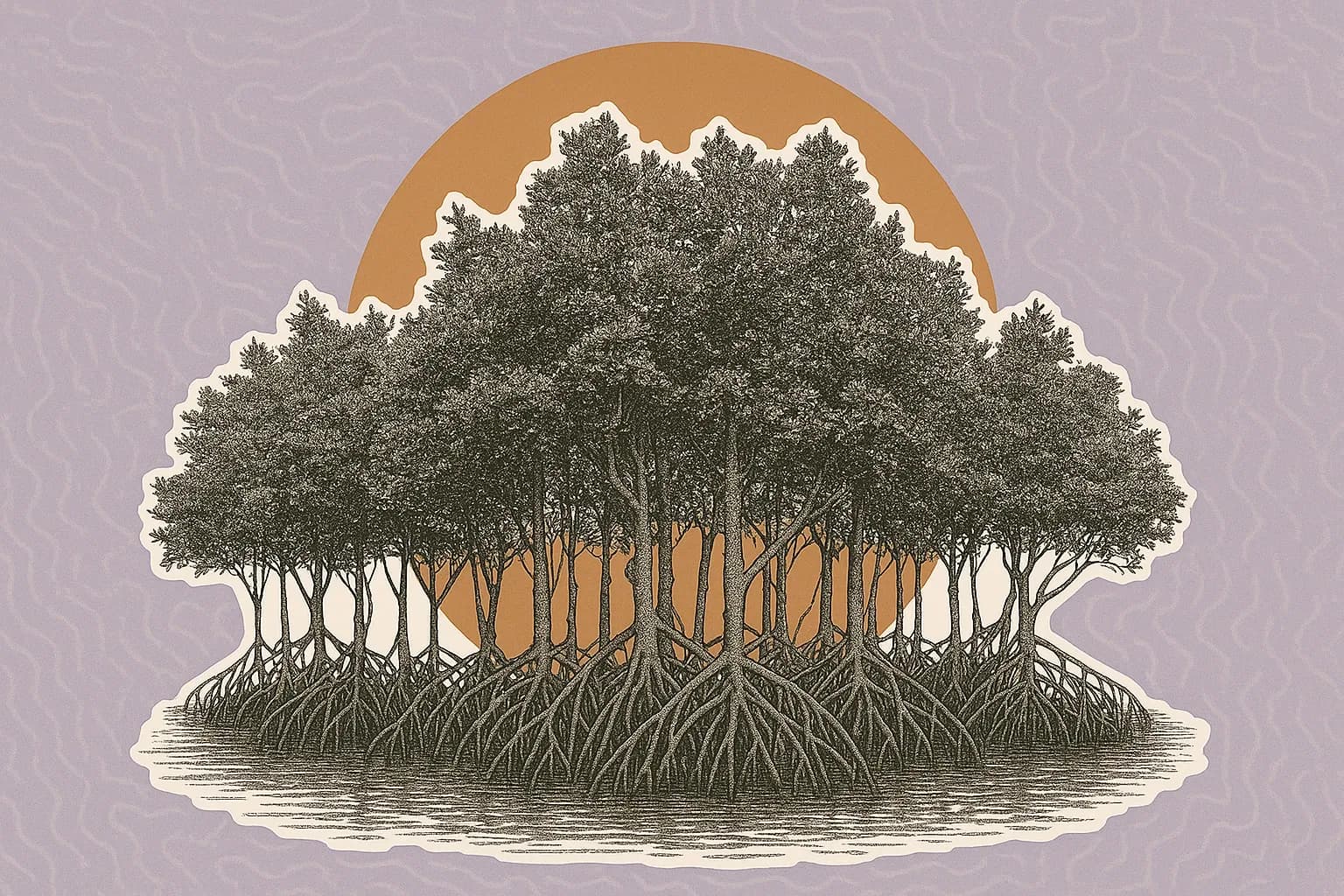
Mangroves play an especially outsized role in coastal health and protecting against environmental disasters. They act as a natural barrier against coastal erosion as the large aerial roots of mangrove trees form a physical shield that buffers coastal communities from ravaging tides and storms3. It was the replanting of mangrove forests that helped Aceh, Indonesia, for example, to rehabilitate degraded coastal areas after the devastating tsunami in 2004. In fact, according to ecological economists, every dollar spent to restore mangroves could yield $6.83 to $10.50 in environmental returns over the next 20 years. Existing mangrove forests can provide up to $9,000 per hectare per year in ecosystem services in coastal regions.
References
1. Ng, P. K. L., & Sivasothi, N. (Eds.). (2001). A Guide to Mangroves of Singapore. The National University of Singapore & The Singapore Science Centre. https://mangrove.nus.edu.sg/guidebooks/text/1016.htm []
2. Yee, A. T. K., Ang, W. F., Teo, S., Liew, S. C., & Tan, H. T. W. (2010). The Present Extent of Mangrove Forests in Singapore. Nature in Singapore, 3, 139–145. []
3. Yang, S., Lim, R. L. F., Heue, C.-R., & Yong, J. W. H. (2011). The Current Status of Mangrove Forests in Singapore. Nature Society. Nature Conservation for a Sustainable Singapore. []
4. Su, J., Friess, D. A., & Gasparatos, A. (2021). A Meta-Analysis of the Ecological and Economic Outcomes of Mangrove Restoration. Nature Communications, 12(1), 5050.
Mangroves support an incredible variety of life, serving as the natural habitats for many species. They form nurseries for marine fish and their roots provide shelter for countless marine life and organisms. Additionally, as these forests are placed near the shoreline, they also support important marine food webs and fisheries, an essential provisioning service for nearby communities that depend on seafood6. A reduction in mangroves could therefore lead to long-term disruptions in local and regional fish populations, impacting both the environment and the livelihoods of those communities. For instance, a recent study conducted in Indonesia found that fishery households experienced up to a 9.8% decline in income after just a 1% increase in mangrove loss in the region7.
On a larger scale, mangroves are critical to regulating dissolved organic carbon in oceans, which plays a key role in the marine carbon cycle. Without them, the composition of coastal marine ecosystems would change dramatically8. Additionally, mangroves (like forests) absorb carbon dioxide from the atmosphere through photosynthesis, leading to the idea of mangroves as ‘carbon sinks’ in the fight against climate change. In these ways, mangroves are beneficial not only to coastal communities but also to the health of the planet.
The above points constitute just a fraction of their ecological importance. Yet, mangroves remain scarce on a land where they once thrived – Friess et al. calls Singapore “a microcosm of the complex relationship between coastal communities and mangrove forests”, saying that “despite the important biodiversity and ecosystem services provided by Singapore’s mangroves more than 90% of their area has been lost”9.
But mangroves are more than just ecological warriors. Long before the arrival of colonialists in the 1800s, mangroves and its resources were central to the lives of indigenous groups of Singapore such as the Orang Laut tribes of Orang Kallang and Orang Seletar. They were places of shelter and sustenance, spaces to pray, play and call home. Villages were located in close proximity or even within mangrove forests up until the late 1980s, with interviews of past residents from the National Archives of Singapore expanding on the intrinsic values of mangroves: a sense of place, an aesthetic value, and a strong cultural and spiritual heritage10.
Sea-based nomads lived “deep in the mangrove swamps” of rivers, collected food in mangrove forests, and gathered mangrove wood for fuel11. Fish-fighting and recreational boating were entertaining pastimes, and local oral histories even include accounts of interactions with spirits that lived within the mangrove forests12. Interviewees in the archives shared that ‘‘the water was only about one feet [sic] from the big house’’ and “during their free time most went to the sea”. As Singapore developed and modernised, mangroves were instrumental to place-naming and identity formation too, like Grove Road, which spans central Singapore to Katong Road.
Today, most interactions with this special landscape are limited to visits for ecotourism. Interviews with visiting locals indicated that the most popularly perceived values of mangroves were recreation, ecotourism, and education13 – far removed from the rich, lived experience of those who once called the mangrove forests home.
In many ways, this transformation, from cultural heart to visit destination, is by design. Notwithstanding the clearing of large swathes of mangroves, what is left of them in Singapore are pragmatically mapped out. Boardwalks with handrails mean that visitors can only walk certain preplanned routes and most flora and fauna cannot be easily reached – you can look, but not truly engage. The educational boards at Pasir Ris Park feature cartoon illustrations and simplified wording, targeting children and tweens, perhaps as a fun attraction for school trips, nary a mention that this used to be someone’s living grounds.
This level of regulation goes not just for the physical landscape but for activities that had commonly occurred in mangroves as well. Amidst boards informing visitors that fish in mangroves used to be caught for income are multiple “no fishing” signs accompanied by NParks’ hotline number, presumably for people to report transgressors. Clearly, those who used to fish in the mangrove have been pushed to eke out a living elsewhere, prohibited to continue their trade. The curation of these spaces has thus greatly reduced options on the experiencing of mangroves besides casual walks and school trips.
Information board in Pasir Ris Park Mangrove
Interestingly, another information board reads in the above picture, “In some countries where the mangroves occur in abundance, the increased production of mangrove products has led to the abuse of this precious resource” with a detached, third-person voice – as if Singapore was not one of those countries where mangroves were prevalent, and as if the primary abuse came from people using its products rather than the clearing of the forests for industrialisation.
Visually, in contrast to the widespread imagery of Singapore as a lush, green, urban “Garden City”, shadowy and swampy mangroves simply appear out of place14. The placement of these forests at the margins of Singapore (Sungei Buloh Wetland Reserve in the northwest and Pasir Ris Park in the east, for example) are a poignant parallel of their relegation in national consciousness.
Still, while not as it once was, Singaporeans have reclaimed a social sphere in the mangroves. Rather than allowing it to stay in the fringes, continuing to visit mangroves offers the unique opportunity of remembrance and appreciation of their vital role firsthand. On a visit to the mangroves in Pasir Ris Park on a casual Sunday, one can expect to pass by handfuls of photographers and birdwatchers chatting softly about their weeks, their families, clearly familiar with one another. The Facebook pages of Nature Society Singapore and Singapore Wildlife Sightings are filled with pictures, comments, and enthusiastic conversation about wildlife in mangroves. The Sungei Buloh Nature Park Network Flora & Fauna group has almost 10,000 members and is constantly updated with different images from mangroves. Even from the boardwalks, even with shoes still clean, not all appreciation is lost with time.
Lastly, beyond the policies and the communities, there is an individual component to the appreciation of mangroves, a role that everybody can play. How do we balance environmental conservation with modern issues of capitalism and resource exploitation? A recent webinar by the Centre for Research on Islamic and Malay Affairs (RIMA) on environmental advocacy introduced the Islamic Ecological Paradigm (IEP) as a possible approach that all of us can take. The paradigm stresses the importance of stewardship and balance in nature and offers valuable insights into how we might approach conservation (including of mangroves) in a way that honours both ecological and social imperatives. For example, we can internalise and practise the concepts of Amanah, which means responsibility, in this case in taking care of the environment that has entrusted to us, or Khalifah, taking on a stewardship role instead of overconsuming natural resources. They point to environmental advocacy as both a moral and civic duty. Taking inspiration from such paradigms can inspire individuals and communities to approach conservation efforts not as a transactional obligation, but as a sacred duty.
The United Nations celebrates the International Day for the Conservation of the Mangrove Ecosystem every 26 July. This article, published just after the 10th year since the day was established, seeks to remind us just how essential mangroves are as ecological shields, historical shelters, and present social spheres. They are symbols of the delicate balance between development and conservation, culture and modernity, and the past and present.
About the Author
Sabrina is a Senior Research Analyst at the Centre for Research on Islamic and Malay Affairs (RIMA). She holds a master's degree in Southeast Asian Studies and is interested in state-society relations and Islamic and Malay history.
5. Yang, S., Lim, R. L. F., Heue, C.-R., & Yong, J. W. H. (2011). The Current Status of Mangrove Forests in Singapore. Nature Society. Nature Conservation for a Sustainable Singapore.[]
6. Friess, D. A., Chua, S. C., Jaafar, Z., Krauss, K. W., & Yando, E. S. (2021). Mangroves and people: Impacts and interactions. Estuarine, Coastal and Shelf Science, 248, 107155.[]
7. Yamamoto, Y. (2023). Living under ecosystem degradation: Evidence from the mangrove–fishery linkage in Indonesia. Journal of Environmental Economics and Management, 118, 102788. https://doi.org/10.1016/j.jeem.2023.102788[]
8. Yang, S., Lim, R. L. F., Heue, C.-R., & Yong, J. W. H. (2011). The Current Status of Mangrove Forests in Singapore. Nature Society. Nature Conservation for a Sustainable Singapore.[]
9. Friess, D. A., Chua, S. C., Jaafar, Z., Krauss, K. W., & Yando, E. S. (2021). Mangroves and people: Impacts and interactions. Estuarine, Coastal and Shelf Science, 248, 107155.[]
10. Thiagarajah, J., Wong, S. K. M., Richards, D. R., & Friess, D. A. (2015). Historical and Contemporary Cultural Ecosystem Service Values in the Rapidly Urbanizing City State of Singapore. Ambio, 44(7), 666–677.[]
11. Singapore Infopedia. (2020). Orang Laut. The National Library Board, Singapore. https://www.nlb.gov.sg/main/article-detail?cmsuuid=e586ffef-6277-4c3d-b463-bd14eefc914f[]
12. Thiagarajah, J., Wong, S. K. M., Richards, D. R., & Friess, D. A. (2015). Historical and Contemporary Cultural Ecosystem Service Values in the Rapidly Urbanizing City State of Singapore. Ambio, 44(7), 666–677.[]