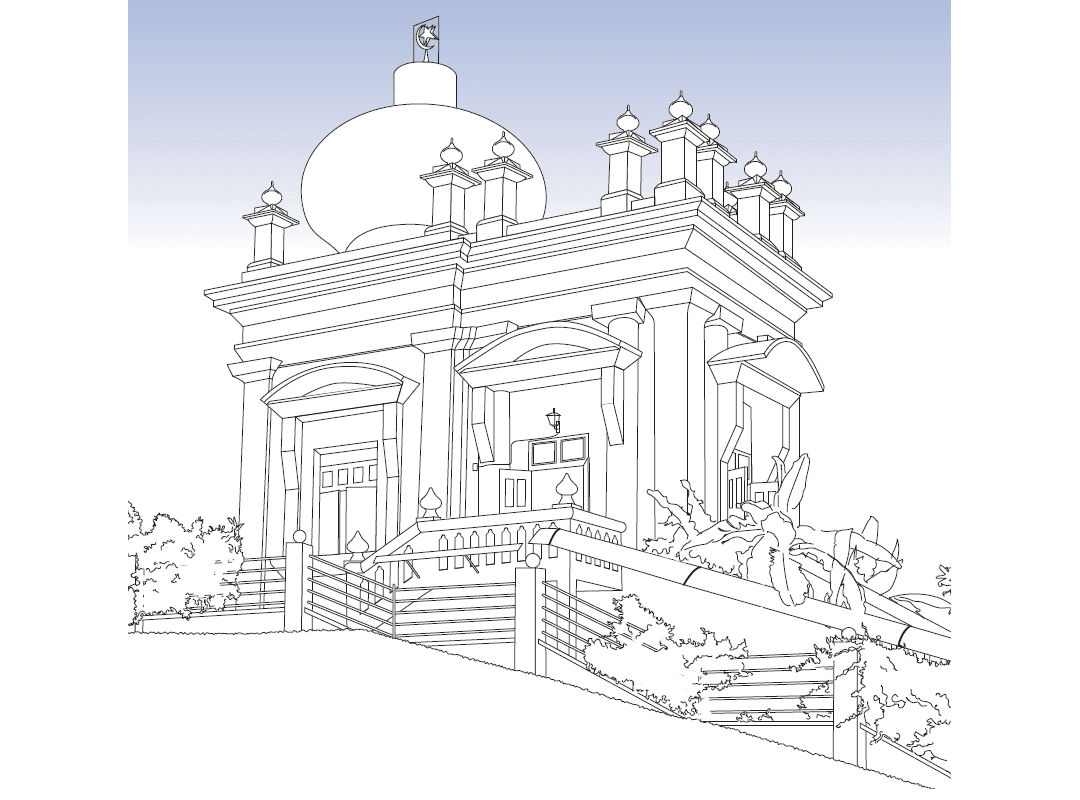
Keramats (or sacred shrines) occupy a peculiar space in Singapore. Against modern skyscrapers and sites of gentrification, these grave-shrines stand out with their old tombstones adorned with yellow pieces of cloth. Certain keramats can be clearly seen in areas such as Fort Canning Park, Outram Park, and even in the Central Business District. However, their numbers have declined steadily over the years, making them a more common sight in the past.
Past locations of these keramats, which have either been exhumed or demolished, can be traced through various historical sources. In 2011, NUS Museum held an exhibition entitled, The Sufi and the Bearded Man: Remembering a Keramat in Contemporary Singapore, which displayed photographs and artefacts related to the past Siti Maryam shrine located at Kallang1. Scholars such as William L. Gibson offer comprehensive works on past and existing keramats, with extensive narration of oral traditions associated with these sites2. Old newspaper articles similarly featured certain sites, implying that they were of public interest. In 19393 and 19524, The Straits Times published two features on keramats, noting how they were respected by visitors of different ethnicities and religions.
A multitude of factors culminated in the steady decline of the popularity of these spaces within the Malay community. An oft-cited reason is the shifts of beliefs within the Malay community in Singapore. Earlier works on that were written by colonial authorities, such as Walter W. Skeat and R. O. Winstedt, characterise - worshipping as Malay practices. While these works lack nuance and do not analyse the influences of different cultures on visiting such spaces, they hint at the pervasiveness of this practice among the Malay community. Other scholars in post-colonial Singapore subsequently tended to address Malays’ lessened interactions with these sites. Cheu Hock Tong historicised the act of worshipping Malay and how the Chinese eventually became primary worshippers of the sites, noting that Malays were no longer as involved as compared to the past. Rivers also notes a “Chinese take-over” of in Singapore. A separate study on the management of Kusu Island cited that close to 100,000 to 200,000 pilgrims visit the island every year, hailing from Singapore and other Southeast Asian states. These visitors are mostly devotees of Chinese folk religion asking for blessings at the Da Bo Gong Temple, who also visit the dedicated to Syed Abdul Rahman, Nenek Ghalib and Puteri Fatimah as part of their pilgrimage. Another , dedicated to Datuk Gong, is located within the Loyang Tua Pek Kong temple. According to the legend stated on the temple’s website, Datuk Gong is a spirit that was once respected by Malays. The Buddhist temple is now mostly known for its ‘multi-religious’ nature, housing different Buddhist, Taoist, and Hindu deities alongside the .
Within the Muslim community, a site that remains popular is the Maqam Habib Noh. Perched at the top of Palmer Hill, the maqam (tomb of a holy Muslim person) lies beside the Haji Muhammad Salleh Mosque. The history of the maqam itself seems to be shrouded in mystery. When Habib Noh passed away, there was an incident that prevented him from being buried at a Muslim cemetery, and it was revealed that he specially chose the hill as his resting place11. A century later, when the Singapore government planned to demolish the maqam to build a highway, the construction company faced many challenges that prevented it from happening. Instead, the Islamic Religious Council of Singapore (MUIS) upgraded the space, allowing it to remain to this day.
Moving beyond the ritualistic importance of such spaces, it is fruitful to think about how these sites are valuable in other ways. In a country where land is scarce, space becomes a large concern for city planners. What bears interest is the remaining keramats in Singapore. With constant redevelopment, keramats that occupy prime land are indicative of a special significance. Indeed, these sites have been deemed as important heritage sites by various organisations, as they offer a rich history that is meaningful to a diverse group of people. Maqam Habib Noh is no exception.
THE MAQAM AS A HERITAGE SITE
The significance of the maqam is undoubtedly tied to the figure behind it. Habib Noh himself is popular among Muslims in Singapore and beyond. He was well-known in his lifetime, especially when he resided in Singapore from 1819 to 1866. Many miracles were also ascribed to him, with oral traditions being passed down and compiled in a biography by Muhammad Ghouse Khan Surattee of Al Firdaus Mosque12. Newspaper articles also featured the Habib, citing him as an important figure in the community13. It is no wonder then that his grave would be deemed significant by many.
Heritage sites in Singapore are often identified by the public but may need recognition from the state. In studying the heritage value of the maqam, it is important to note the history of heritage conservation in Singapore. Kevin Blackburn and Alvin Tan Peng Hong suggest that preservation efforts of certain buildings were already made in late colonial Singapore14. After World War II, urban planning in Singapore was primarily concerned with controlling the density of different areas of Singapore. However, the 1955 Master Plan included a table listing, Ancient Monuments and Land and Buildings of Architectural And/Or Historic Interest15. Of these 32 sites, 25 were either churches, temples, mosques or graves, which included Maqam Habib Noh. Blackburn and Tan further argue that these buildings were chosen due to Western ideas of heritage, which was concerned with the “authentic and original”. For Singapore, these sites were either of ethnic or religious importance.
Being on the identified list did not actually exempt sites from being demolished for urban redevelopment in the 1960s. Blackburn and Tan cite the Hajjah Fatimah Mosque and the Outram Park Prison as prime examples. The mosque was allowed to remain despite the demolition of most of Kampong Rochor, while the prison was demolished in 196616. Certainly, it is important to note the different significance of the spaces as Hajjah Fatimah is an important figure in Singapore and was laid to rest in the premises of the building with other descendants of the Alsagoff family17. Nonetheless, the case of the prison showed that there were no proper stipulations to protect sites that were on the list. Being gazetted may not necessarily bring tangible benefits to the site, especially when it comes to remaining in the ever-changing landscape of Singapore.
Despite Maqam Habib Noh no longer being on the list of gazetted buildings by the Preservation of Monument Board from the 1970s, scholars and activists still consider it a heritage site. Hence, it is important to consider how the discourse on heritage in Singapore has shifted over the years. In the 1980s, heritage in Singapore became tied to tourism as it became a prominent source of revenue. Blackburn and Tan argue that Western hegemonic thoughts of heritage were most prominent in the 1950s, with its legacy still manifesting in how buildings are officially considered worthy of preservation. Heritage remained tied to showcasing different ethnicities as “Asianness” became a way for Singapore to showcase itself as a special “global city”18. Religious sites seem to perpetuate this image and subsequently became national monuments, accounting for almost half of this list19. Although there are mosques on the list, keramats are noticeably excluded. This is perhaps indicative of how keramats may not be officially considered a religious site by the different governing bodies in Singapore.
While it appears that the state is the final arbiter of determining heritage sites, the role of non-state actors should not be neglected. From Blackburn and Tan’s article, there were already groups such as Friends of Singapore that advocated for preservation. However, other voices appear to be mostly marginalised until 2001. Yuen cites the Urban Redevelopment Authority’s 2001 Master Plan as significant in stipulating public participation in determining heritage sites, especially for those in the communities associated with the space20 In the case of Palmer Road, scholars and activists have been active in calling for its conservation due to its rich history. For example, Johannes Widodo wrote a paper in 2004 on the area as a “humble attempt to bring attention” to the different historical sites in the vicinity21. One such site is Tanjong Malang, citing its historical significance as the location of the Syed Yasin Keramat that was erected in 1823. Multi-ethnic villages were also located nearby housing the Parsi and Hakka communities. Other than Maqam Habib Noh, there were other historic places of worship such as the Fu De Chi temple and the Seng Wong Beo temple, built in 1844 and 1906 respectively. Kampung Sambau was also a significant site that existed where the maqam is located22. The village’s occupants were Melaka Malays and it was also the home of Haji Muhammad Salleh, the man behind the mosque built near the maqam in 1903. Singapore Heritage Society has also been conducting studies on Tanjong Malang and even brought groups on heritage walks.
In 2015, The Straits Times published an article on Maqam Habib Noh as a “historic” site23. In the midst of its plans for upgrades, it was hoped that the maqam would be given “preservation or conservation status”. Other than having heritage value, it is a space of ‘tranquility’ within the Central Business District of Singapore. In its shared environment within the city, the significance of the maqam is now expanded beyond being just a keramat. It seems that the only way to further elevate the maqam as a heritage site is getting it gazetted by the state. One of its latest existential threats was the building of Prince Edward MRT Station. It is now planned to ‘skirt around’ the maqam, assuaging previous fears that the maqam would be demolished for the station. Instead, other sites such as Palmer House would be demolished as the involved governing bodies wanted to leave “structures with the most heritage value” intact24. However, heritage researchers report that the lease of the Maqam Habib Noh and the nearby Masjid Haji Muhammad Salleh are expected to expire in 202525. While one can’t predict the state’s decision- making process when it comes to such spaces, we can be hopeful that community efforts do play a part in highlighting the significance of different sites in Singapore.
SITES AS PUBLIC MEMORY
Amid researching about keramats in Singapore, I personally sensed a palpable loss as many such sites no longer exist in Singapore. This only makes current efforts to conserve remaining keramats more important to support as they are valuable, tangible sources of history and culture. A recent example would be the Moonstone Lane Keramat, which was discovered in 2019. Although it was virtually unknown before then, members of the community such as Assistant Professor Imran Tajudeen from the National University of Singapore's Department of Architecture was able to garner interest in investigating the site. To this day, it remains undemolished as it was argued to be the resting place of Syarifah Zainah, a descendant of Habib Noh and the Aljunied family26 . By collectively deciding what sites remain important in Singapore, we can hopefully play a bigger role in deciding what remains in our public memory in the time to come. ⬛
Wan Nur Syafiqa is a Research Analyst at the Centre for Research on Islamic and Malay Affairs (RIMA). She graduated with a Bachelor’s degree in History from the National University of Singapore. Her research interests include Heritage and Islam in Southeast Asia.