More than a Game of Wheelchair Rugby: Rewriting What Strength Looks Like | Karyawan
More than a Game of Wheelchair Rugby: Rewriting What Strength Looks Like
Qamar Jannah Fateen
30 Dec 2025
10 min read
The first thing that stood out when we were sitting on the bleachers on 27 September 2025 was the sound. Not the squeak of shoes against the hardwood floor like most would expect, but the sharp collision of metal frames and wheelchairs crashing into one another with force, precision, and intent. The atmosphere was truly exhilarating, as players and spectators all cheered together whenever there was a close score. This was not just any sport – this was wheelchair rugby.
The Karyawan team was present at the inaugural Singlife Wheelchair Rugby Corporate Challenge that took place at the North London Collegiate School (Singapore), where representatives from Singlife’s partners and Berita Harian took to the court in a friendly wheelchair rugby match alongside athletes from the Wheelchair Rugby Association (Singapore) (WRAS). Organised by WRAS, the event built on the momentum of the Singlife Wheelchair Rugby Cup held earlier in April this year. Bringing together wheelchair rugby athletes and able-bodied participants in a shared sporting space, the Corporate Challenge sought to raise awareness of para-sports, challenge prevailing assumptions about disability, and encourage greater public engagement with a sport that often remains out of sight. This initiative forms part of Singlife’s broader commitment to fostering inclusivity, resilience, and progress in Singapore’s sporting community. Under its SG60 and Beyond campaign, Singlife has entered a partnership with WRAS as title sponsor, supporting the sport’s development and visibility in Singapore. These efforts contribute to WRAS’s longer-term aim of building a strong and competitive national team for the ASEAN Para Games in 2029, which Singapore is set to host.
By the end of the event, it became clear that as a sport, wheelchair rugby built a community through a common interest and goal and redefined common notions of strength. Centring the lived experiences of wheelchair rugby athletes, this article aims to highlight the importance of representation for persons with disabilities (PwDs), and how sport, community, and visibility enable them to navigate everyday challenges and reclaim their agency.
References
1.Vanlandewijck, Y. C. (2016). Contribution of sport science to performance: Wheelchair rugby. Training and Coaching the Paralympic Athlete, pp. 172-198. https://.doi.org/10.1002/9781119045144.ch9[]
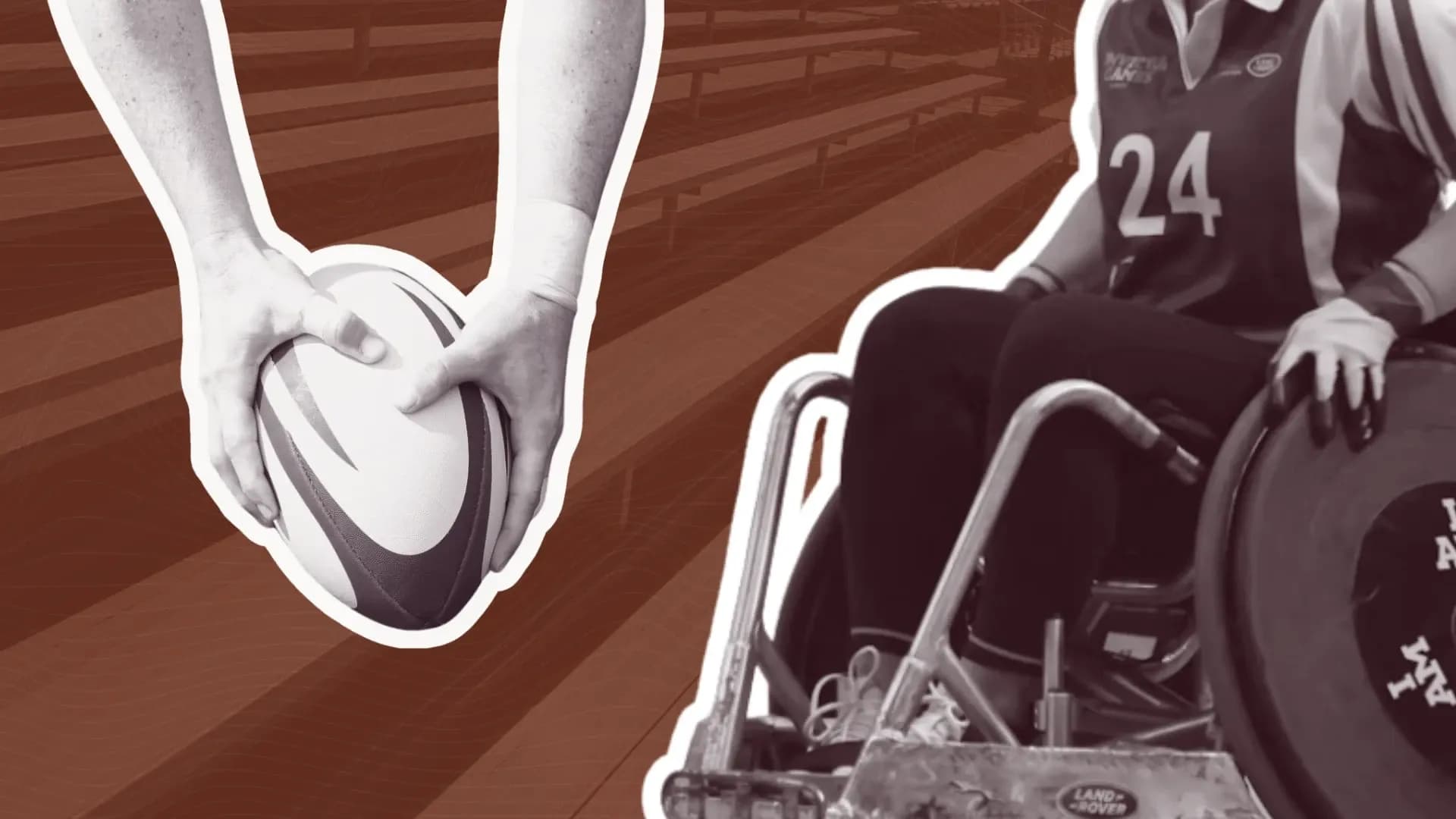
Often misunderstood or perhaps a little unfamiliar to the wider public, wheelchair rugby is a high contact, fast-paced team sport designed for athletes with physical disabilities. Originally developed in Canada, the sport draws on elements of rugby, basketball, ice hockey, and handball. Players compete to carry the ball in firm control across the opposing team’s goal line1. Contact between wheelchairs is permitted and is in fact fundamental to the sport, as players use their chairs to strategically block, hold, and collide with opponents, making the sport as intense and tactical as it is dynamic.
Coach Azhar briefing players on the rules and flow of wheelchair rugby. Source: Author.
There are two different types of wheelchair rugby chairs: offensive and defensive wheelchairs. As the names suggest, offensive chairs are designed for speed and agility, featuring rounded front bumpers and protective wings that reduce the chances of other players hooking onto them. On the other hand, defensive wheelchairs are built to disrupt play, with bumpers set up to hook and hold other players. Offensive wheelchairs are usually used by players with more physical capabilities, and defensive wheelchairs are most often used by players with lesser physical capabilities2.
Today, wheelchair rugby is firmly established on the global sporting stage as a Paralympic sport. More than 28 countries have competed internationally and are ranked worldwide, with many other actively developing national programmes, a testament to the sport’s growing reach and recognition3.
Finding the Sport
For some athletes in that very court, wheelchair rugby entered their lives unexpectedly, rather than through formal institutions or early exposure. The Karyawan team sat down with two athletes, Nur Sabrina and Adil Khalip, to learn more about their journeys with the sport.
For Nur Sabrina, wheelchair rugby was introduced to her by her swimming coach who was helping her with hydrotherapy.
“At first, it honestly sounded quite scary.” Sabrina admitted. However, she soon found herself changing her mind. “But after trying it myself, I really like how bonded the team was. It felt very connected, like a community that welcomed me.”
Joining wheelchair rugby marked a turning point in Sabrina’s life. Before that, she described her days as largely sedentary. Working as a graphic designer meant spending long hours at her computer, with limited physical activity beyond short trips around her neighbourhood.
“I rarely went out. [But] after rugby, I started discovering other para-sports too; boccia, wheelchair bowling, and realised there’s actually a whole community that’s accessible and inclusive for wheelchair users like me.”
Meanwhile, for Aidil, wheelchair rugby entered his life following a road traffic accident in 2013 that resulted in an acquired physical disability. After spending close to a year in hospital undergoing rehabilitation, Aidil was gradually reintroduced to sports through fellow amputees he met in his ward. Having always been an active and sports-inclined person before his accident, the idea of returning to sports felt both familiar and daunting.
Over time, Aidil experimented with various individual para-sports such as table tennis. It was only in 2016 that he discovered wheelchair rugby; a turning point that would shape the years that followed.
“Once I found wheelchair rugby, I became fully involved. Then I’m totally involved until now.”
Conversations with these two players revealed stories of their daily lives revolving around adapting and navigating public spaces, negotiating assistance, and managing the emotional weight of being perceived as dependent. In the beginning, and especially in the most difficult periods, sport was not an obvious option to both Sabrina and Aidil. Wheelchair rugby changed that.
Starting wheelchair rugby was not without its challenges for Sabrina. The sport requires high levels of strength, stamina and consistency, something she had to actively maintain alongside her work commitments.
“If I miss even one or two session[s], I can really feel my stamina drop. […] It made me realise how much discipline the sport requires.”
Entering a male-dominated space also took adjustment, but nothing that stopped Sabrina from loving the sport.
“Most of them are men, and they’re very rough,” she said with a laugh. “It’s tough love lah.”
Over time, Sabrina learned to reframe her approach to the game, reminding herself that enjoyment mattered just as much as performance.
For Aidil, his initial doubts revolved around whether he could succeed in a team-based sport. Having previously participated mostly in individual disciplines, adapting to teamwork came with emotional and social challenges. With diligence and practice, however, adaptability became his strength. Training alongside teammates with different backgrounds and stories taught him how to adjust to others, communicate, and grow collectively. Today, what keeps Aidil going is not just personal improvement, but the growth of those around him too.
“What makes me motivated? It’s actually more of the journey with me and some of my teammates, especially because I want them to improve. […] I’d rather they come out from their comfort zone, and join the sport, [...] they come to training, they [have won] one half the battle already.”
Recurring themes emerged across their interviews – not only did the sport improve physical strength, it also restored confidence and a sense of purpose. For Sabrina and Aidil, it was perhaps the first time their bodies were framed not as functions to be managed, but as tools capable of strong performance.
Mr Muhammad Taufik, WRAS athlete, briefing his team (Source: Author)
Community, Belonging and Advocacy
The Karyawan team also spoke with Coach Azhar, who currently coaches the team from WRAS. What stood out most was how deeply the role has shaped him. Reflecting on his first encounter with the team, Coach Azhar shared that each athlete carried a story marked by loss, resilience, and adapting to new lifestyles, as many acquired disabilities through accidents. Yet, rather than allowing themselves to be defined by these experiences, he observed something else entirely.
“My first impression is really that these bunch of amazing people [...] each have their own unique origin story as to how they - for some of them - acquired disability. They unfortunately got involved in an accident, and then that’s how they became physically disabled. [...] Despite all of those challenges, they are happy people, they are very confident, they have got strong self-esteem, and they have a stronger meaning to life.”
Hearing and witnessing the athletes’ stories reframed Coach Azhar’s understanding of how one can be really committed to something, despite apparent barriers. He shared that what keeps him returning to training week after week is the athletes’ discipline and commitment; not only to the game, but to themselves and one another. He believes that more people need to hear their stories, precisely because they challenge dominant narratives around limitations.
For Aidil, visibility is central to changing how para-sports, and disabilities more broadly, are understood in Singapore. He acknowledged that barriers still exist, particularly in how society perceives disability.
“When you have a physical disability, people can see it. Some of us may need help, but many of us are also very independent. […] Para-sports should be treated the same as able-bodied sports. [...] We train just as hard. Inclusivity means recognising that there is no difference in effort or commitment.”
Kelvin & Frank Reid Team rallying together ahead of the match (Source: Author)
Looking Forward
When asked about hopes for the future, both the athletes and Coach Azhar were enthusiastic about normalisation; a future where wheelchair rugby and para-sports are not treated as niche, but recognised as an ordinary and valued part of Singapore’s sporting landscape.
Coach Azhar emphasised that for wheelchair rugby to grow sustainably, the ecosystem around it must expand as well. This refers to building a team of referees, physiotherapists, technicians, and volunteers. He drew parallels to the recent World Para Swimming Championship and reflected on how Singaporeans rally behind athletes especially when their stories are visible and meaningful. Success and visibility, he noted, can unite Singaporeans and imbue us with a sense of pride. He expressed his hopes for the Singapore team to play in the international space:
“If the wheelchair rugby can do well at the international space, I think it raises awareness of the sport. Those who have not heard of wheelchair rugby before would get interested.”
For Sabrina, para-sports has the power to reshape how society understands disability through visibility and awareness of the sports. She believes that with greater representation, she hopes people will become more comfortable, less awkward, and more open towards people with disabilities.
“When you see it more, you’re more used to it. That’s how acceptance grows.”
For Aidil, visibility is central is to changing how para-sports are understood in Singapore.
“Wheelchair rugby is about inclusivity,” he explained. “I want people to know what wheelchair rugby is about. When people think of para-sports, I hope wheelchair rugby comes to mind.”
They imagine a Singapore where para-sports are longer treated as niche, where accessibility for all is built into spaces and systems from the start, and where participation is based on interest, not perceived capability.
After the final whistle was blown and medals were awarded, the court gradually emptied; still, the impact lingered. The Karyawan team remained behind, sharing casual conversations with Coach Azhar and a few other players. Wheelchair rugby, as it turns out, is more than just a sport for them. It is a way to manifest that strength is multifaceted, community building is intentional, and inclusion is something that we build together. As Coach Azhar said:
“It is about putting ability before disability and having that mindset that I can do this. Everything is possible.”
About the Author
Qamar Jannah Fateen is currently a Research Analyst at the Centre for Research on Islamic and Malay Affairs (RIMA). She holds a master's degree in international development practice, specialising in sustainable economy. Her current research interests include social inequality, cultural development and diaspora of Austronesians/Malays.