Navigating Interfaith Harmony in Singapore | Karyawan
Navigating Interfaith Harmony in Singapore
Illya Nabilah Abdul Manaf
31 Oct 2025
9 min read
In a multifaceted country like Singapore, the community is no stranger to conversations surrounding religious harmony. While Singaporeans grew up hearing messages emphasising racial and religious peace from our nation’s leaders, how many of us really understand what it means to live harmoniously? And beyond that, is religious harmony simply about tolerance, or are Singaporeans actively engaging with and learning from one another through interfaith?
Importance of Interfaith Relations
Data from Pew Research Centre revealed that Singaporeans reported higher levels of tolerance for different faiths compared to other regional countries surveyed1. This could be attributed to the exposure to various ethnicities and cultures since the nation’s independence, coupled with leaders’ emphasis on harmony. But while intercultural and interfaith interactions in Singapore are generally positive, they could also be sources of tension and conflict between different communities. A recent incident of the delivery of pork to mosques around the island with ill intent highlights that threats to Singapore’s religious harmony still exist despite ongoing interfaith initiatives by leaders and the public2. This underscores the necessity of interfaith relations to extend beyond mere tolerance through substantive interactions among different faiths in order to effectively mitigate such acts.
How can this be achieved? One step in attaining harmony across different groups is through dialogues3. The term “dialogue” can make interactions with others seem forced, passive, or monotonous, but in reality, these interactions can occur in informal ways: through shared passions, common interests, or day-to-day interactions, all of which can make interfaith conversations more interesting and forge friendships across religious divides. A paper by Lawrence also found that interfaith dialogue and interactions deepen participants’ faith as well as understanding in their own religious teachings. Thus, interfaith relations enable us to reflect on the lack of knowledge in different areas of our faith and encourage us to explore it even deeper. In this way, interfaith relations have significant impacts on both societal and personal levels.
References
1. Loh, R. (2023). “Pew study hails Singapore’s ‘remarkable’ religious diversity and high tolerance, acceptance.” Channel News Asia.[]
2. Lam, L. (2025). “Man charged with sending envelope containing pork to Al-Istiqamah Mosque in Serangoon.” Channel News Asia.[]
3. Ahmed, A. (2018). Afterword: A Reflection on the Crucial Importance of Interfaith Dialogue. The Review of Faith & International Affairs, 16(3), 114–118.[]
4. Lawrence, M. E. (2015). The Face to Faith Program of the Tony Blair Faith Foundation. In Mrahorović, S. (Eds.), Proceedings of the 11th Doha Interfaith Conference: Role of Youth in Enhancing the Value of Dialogue (pp. 40-43) /Doha International Centre for Interfaith Dialogue (DICID).
However, dialogues can be difficult uphold amid evolving social changes. According to a commentary by Nazhath Faheema, interest in interfaith dialogue in Southeast Asia has been declining at an alarming pace, partly due to shifting generational values such as the increased reliance on digital communication5. While online platforms have broadened access to information, interfaith conversations on these platforms have also reduced opportunities for face-to-face encounters that can foster emotional intimacy and genuine understanding across faiths. In relation to this, Smith argued that interfaith initiatives are often perceived negatively, with connotations of being boring or disengaging for youths6. Many may perceive these initiatives to be “done for them rather than by them”, highlighting a lack of youth ownership in interfaith initiatives and diminishing their interest and active participation. Nonetheless, interfaith dialogues are not aimed at converting or convincing others to embrace a different religion, but to encourage critical thinking and build understanding. Only in spaces with diverse thoughts can we truly reflect on values that have been passed down to us. Ahmed similarly wrote that people typically attend interfaith dialogues at a mere surface level – they engage in interfaith discussions but fail to put in sustained efforts to deepen those relationships afterwards7.
Yet, interfaith bonds are still key to broadening one’s understanding of diverse religious perspectives and forgoing negative preconceived notions of other religions, to create genuine harmony among people of different backgrounds. Building authentic bonds across religious communities empowers people to engage more critically with information that may pose a threat to religious harmony, rather than blindly accepting different narratives. Overall, these trends signal a need to refresh interfaith initiatives to better connect with today’s communities and inspire deeper participation and empowerment.
Efforts towards Interfaith Advocacy
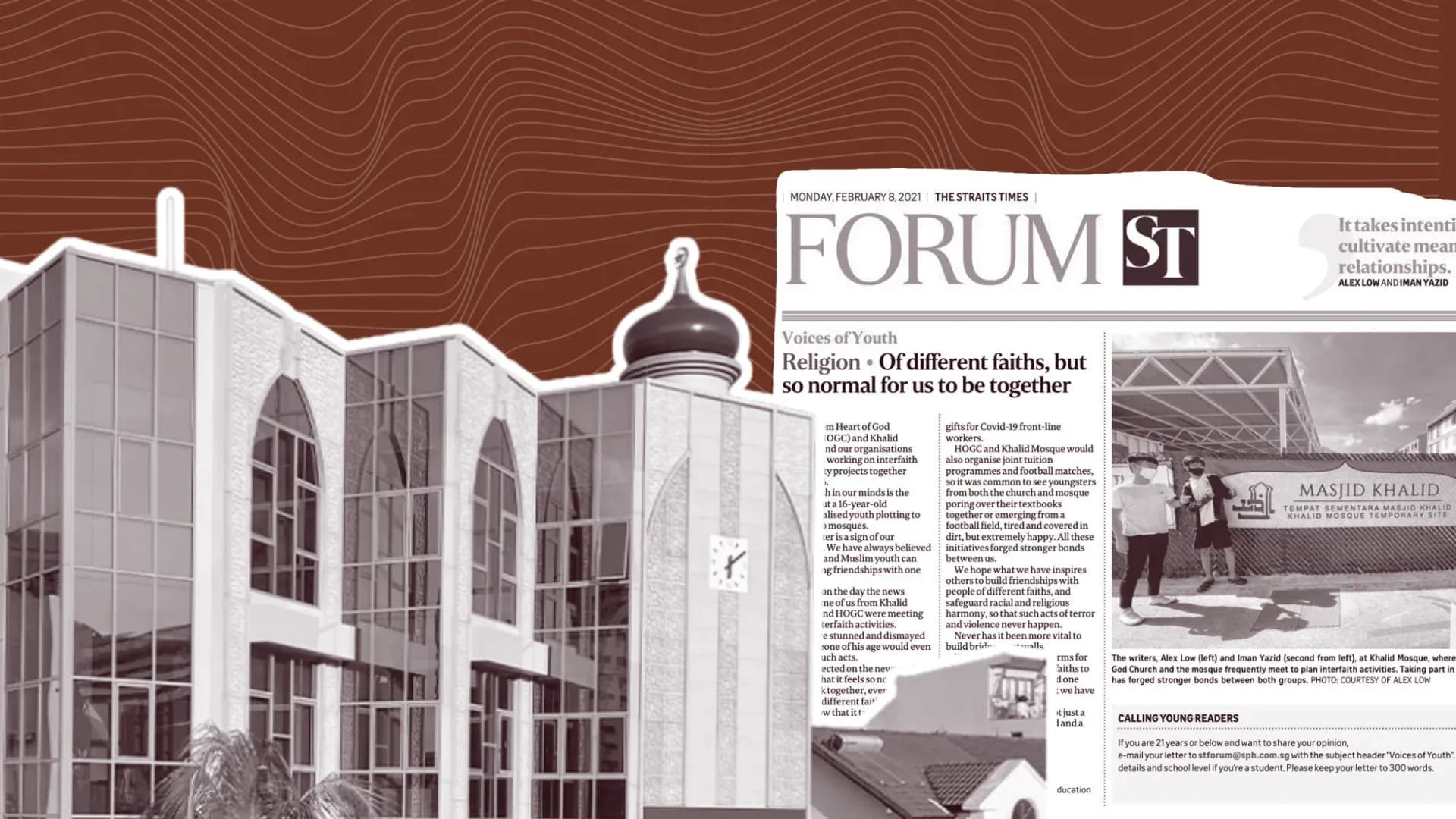
To delve deeper into how renewed interfaith efforts are taking shape in Singapore, who better to speak to than individuals who are directly involved in such activities? We spoke with Alex Low, the co-founder of Interfaithsg and youth leader from Heart of God Church, and Ustaz Ridha Azib, Community Engagement Officer from Khalid Mosque, to uncover the reality of interfaith among the general population and the barriers to interfaith advocacy. Interfaithsg is a youth-led initiative by Heart of God Church that advocates for interfaith harmony through community-driven projects. Together with Khalid Mosque, Geylang United Temple, Racial and Religious Harmony Circle, Singapore Red Cross and other religious entities, Interfaithsg has organised more than 140 programmes including interfaith charity drives, sport tournaments and tutoring for lower-income students8.
When asked about the challenges of interfaith work, Ustaz Ridha observed that sustaining long-term engagement across communities following interfaith events remains a significant challenge. This insight supports Ahmed’s aforementioned point on the importance of strengthening bonds beyond the first point of contact, highlighting that a significant part of interfaith work is nurturing long-term connections among different communities. In building these lasting connections, Alex highlighted an important factor: the role of youth ownership in ensuring the sustainability of interfaith initiatives for future generations to come. Youth ownership ensures that interfaith efforts are not temporary and are rooted in shared interests and values of the current younger generation. For example, initiatives that are motivated by moral acts like charities or are simply shared hobbies serve as a medium for people to have informal conversations about faith. Ustaz Ridha mentioned:
When people come together naturally for a shared purpose, they experience the beauty of interfaith harmony through action rather than discussion. That’s when it becomes more meaningful and relatable to the broader community.
In addition to this, Alex expressed his thoughts on the reality of religious harmony:
The basis of interfaith efforts is people of different faiths coming together. Yet harmony isn’t just the responsibility of religious groups, it’s for all of us. That is whyit is important for interfaith work to remain visible and accessible to the wider public, even to those who may not be part of a religious organisation.
These excerpts highlight the collective responsibility of interfaith efforts that extend beyond religious organisations. Further supporting this point, Ustaz Ridha asserted that interfaith work does not only comprise organising events; but building trust, nurturing understanding at a personal level and forming genuine friendships. This approach to interfaith underscores how social trust can be strengthened through shared dialogues and creative collaborations across faiths, regardless of personal or religious values. Brought together, Alex and Ustaz Ridha shed light to the essence of collective responsibility and youth ownership in the challenge of sustainability of interfaith efforts.
A recent podcast by the Centre for Research on Islamic and Malay Affairs (RIMA) on interfaith advocacy featured guest speakers from interfaith organisations who shed light on other issues within the interfaith scene. Fahima Farha from Roses of Peace, a not-for-profit, youth-driven organisation dedicated to fostering social cohesion in Singapore, expressed:
How do we get those who are not on the table to be part of this conversation? How do we access them? And how do we even create that slight interest in them to be part of this conversation, right?
This suggests that another key challenge in fostering interfaith harmony today is sparking the curiosity of those who are uninterested in interfaith issues, emphasising the necessity for strategies that encourage broader societal participation. In Singapore’s context, there is already a rich and creative landscape of interfaith initiatives, covering everything from music festivals to blood donation drives, which are the perfect opportunities to pique the interest of diverse groups9. Moving beyond interfaith dialogues, these initiatives provide practical ways to build trust and understanding through the creation of shared spaces where people can connect on common goals and values.
The Role of Religious Leaders in Interfaith Advocacy
During our conversation with Alex, he also emphasised the role of religious leaders in promoting interfaith:
My leaders in church were always there to walk alongside me and my friends. They guided us, shared wisdom from their years of experience, [...] and supported us every step of the way. It showed us that our ideas were valued, and gave us the courage to step up, try, and learn.
Alex’s experience with church leaders reflects how religious leaders ought to be open to innovative approaches to interfaith and encourage the participation of the broader community in these initiatives. As a society, we should move beyond mere coexistence by being open to hearing how others perceive our faith and sharing our own lived experiences with different religions10. This allows society to find common grounds and ultimately develop respect and acceptance of differences. Hence, religious harmony can be built on curiosity about other faiths and an interest in dialogues or creative initiatives.
Other instances of interfaith advocacy among religious leaders include the late Pope Francis’ visit to Singapore in 2024, where he encouraged and inspired youths to participate in such initiatives and take risks in the name of interfaith cause11. Singapore’s religious leaders too consistently show support for each other’s faith by attending religious celebrations and speaking out against religious discrimination, such as the aforementioned pork incident where representatives from different religious organisations came out to criticise the offender’s actions. As such, religious leaders in Singapore have played an active role as symbolic figures and inspiring models within their communities in ensuring interfaith harmony, proving that they have successfully set the tone for interfaith in Singapore.
That being said, how do we promote truly grounded interfaith advocacy where not only religious leaders or representatives are involved in these works, but also the members of each religious community? It is then the role of leaders to promote interfaith initiatives on a smaller and more accessible scale. One practical way to achieve this is through the integration of interfaith messages and invitations to different events during religious sermons and congregations, so that these works are visible to the general religious community who might be interested in participating in such activities but are uncertain of the points of entry.
Singapore’s interfaith landscape proves that religious harmony is indeed attainable with collective efforts and initiatives. Taking Interfaithsg, Heart of God Church, Khalid Mosque and Geylang United Temple as inspiring examples, it is hoped that their collaborative interfaith efforts inspire other religious institutions to engage in such activities to encourage religious harmony across different audiences.
Nonetheless, more efforts in making interfaith more accessible should be made within each religious space, as the interfaith community still faces challenges in sustaining long-term engagement and sparking the interest of the broader population. After all, it is essential that society upholds the collaborative bonds between different religious groups to promote sustained commitment to interfaith harmony and understanding for all beliefs.
About the Author
Illya Nabilah is a recent graduate from International Islamic University Malaysia (IIUM) and a Research Intern at Centre for Research on Islamic and Malay Affairs (RIMA). Her research interests include social inequality, cultural diversity, and interfaith relations.
6. Smith, A. B. (2015). Exploring Personal Narrative as a Tool for Enabling Young People to Participate Fully in Authentic Dialogue. In Mrahorović, S. (Eds.), Proceedings of the 11th Doha Interfaith Conference: Role of Youth in Enhancing the Value of Dialogue (pp. 83-95). Doha International Centre for Interfaith Dialogue (DICID).[]
8. Yusof, Z. M. (2024). “Interfaith blood donation drive seeks to build social cohesion among young donors.” Straits Times; About Interfaithsg. (n.d.). Interfaithsg. []
11. Koh, F. (2024). “Youths must have ‘courage’ to hold interreligious dialogues, take conversation to wider community: Pope Francis.” Channel News Asia. []