Places to Become, and Not Just to Be: The Trajectory of Third Places | Karyawan
Places to Become, and Not Just to Be: The Trajectory of Third Places
Hani Mokhri
29 Aug 2025
11 min read
Community- or Lack Thereof
In a 2025 study by Institute of Policy Studies (IPS), it was found that the average number of close friends the average youth has today has decreased by around 4, bringing it down to an average of 6 close friends per person from an average of 10.67 in 20181; another poll by IPS in 2023 revealed that youths between the ages of 21-34 had higher loneliness scores compared to their counterparts from older age bands2. A related phenomenon we have been seeing recently is the surge of community-building social organisations, such as Offline and FriendZone3, among many others. All in all, these phenomena seem to point towards a growing loneliness epidemic. Youtuber Mina Le’s video essay on friendships, in which she acutely discusses the impacts technology has had on our friendships, can be drawn upon to understand why. For one, the widespread use of technology promotes transactional relationships; the convenience of “access” to friends reduces the value of time spent in real life with friends4. CNA also touches on how, in the context of Singapore, this is further compounded and exacerbated by our pervasive culture of self-reliance and shame5.
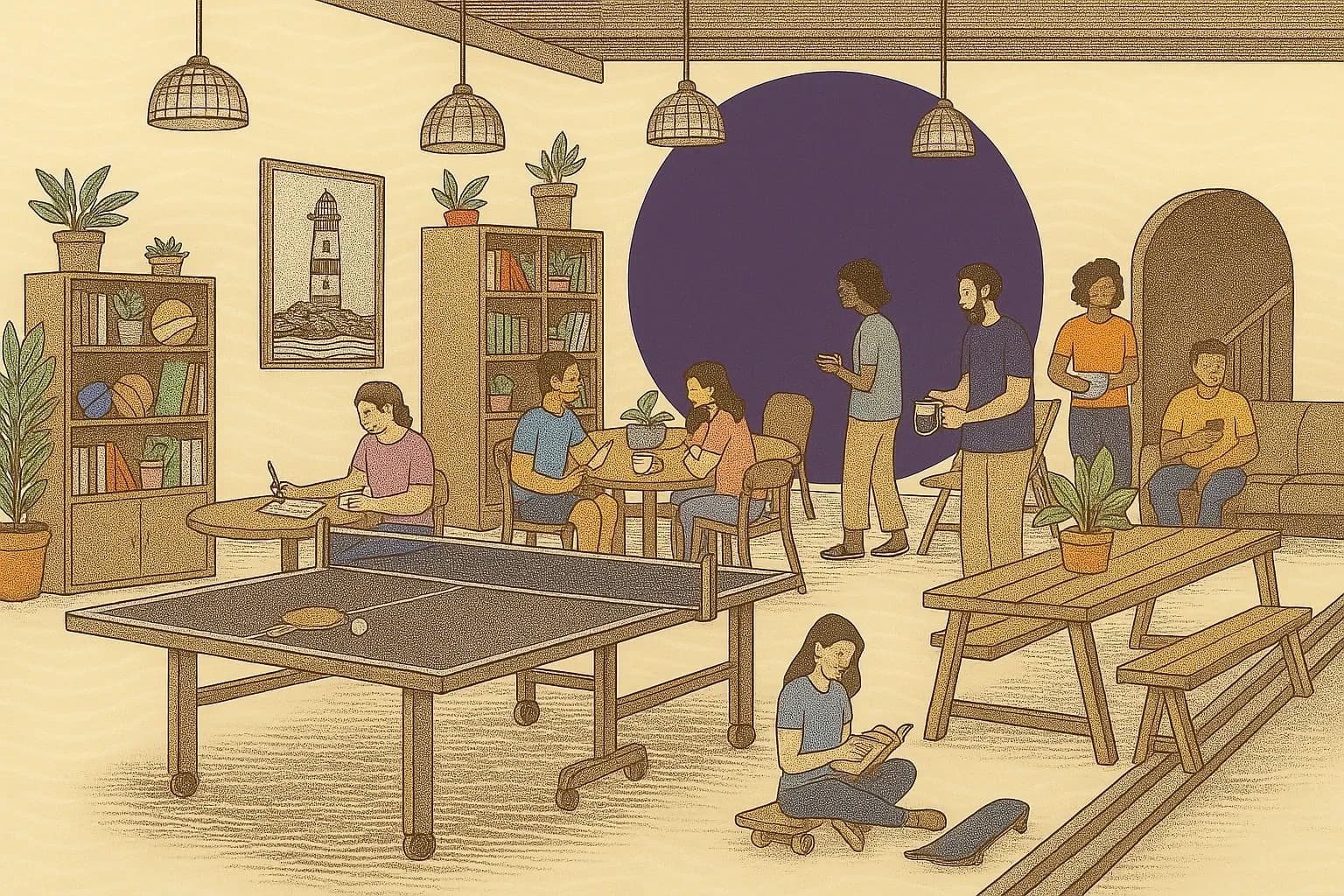
Therefore, it is no surprise that the word community has gained much traction of late. However, what we still lack is the acknowledgement and the realisation that these communities are traditionally built in third places — places between work and home that act as conduits for organic social interactions. With the decline of these places, how then do we retain the same sense of community?
References
1. Mathews, M., Teo, K. K., & Tay, M. (2025, March). Friendships in flux: Generational and socio-economic divides in Singapore (IPS Working Paper No. 62). Institute of Policy Studies, Lee Kuan Yew School of Public Policy. []
2. Institute of Policy Studies. (2023). SP2024 Pre-Conference Poll. https://lkyspp.nus.edu.sg/docs/default-source/ips/findings-from-sp2024-pre-conference-poll.pdf[]
3. Offline and FriendZone are social networking groups that host events for people to hang out and engage in casual conversation; these conversations build on day-to-day, relatable topics such as friendships, marriage, and the like. []
Much of my teenage years was spent on TV shows, and for one reason perhaps– I was a lonely teenager left to my own devices and watching them helped me live vicariously through them. What they had in common was a sense of camaraderie and friendship so palpable I could feel it through the screen. It was only years later I understood why— they all had places to hang out, a “headquarters” of sorts where people could touch base and cultivate the type of friendships I longed to have; Gilmore Girls had Luke’s Diner, Friends had Central Perk, while Dr. Who had the TARDIS.
These places are what Oldenburg refers to as third places. In his book, he describes the characteristics of the ideal third place, one of them being its role as a “leveller”—people from diverse backgrounds could come together in spite of their differences7. If you asked random people on the street to name a third place in Singapore today, I suspect the ubiquitous idea of such places would likely conform to some sort of mall or hub—spaces of consumption, often delineated by financial barriers. Oldenburg also mentioned how third places should be neutral ground; people should have the liberty to come and go as they please8. Essentially, what it means is unlike home (first place) and workplace (second place), where one is bounded by obligations and structure, third places are characterised by the opposite. More and more, we see that this is not the case, with people frequenting third places not with spontaneity, but as part of routine catch-up sessions scheduled in advance. In these meet ups, instead of creating new memories, time is often reminiscing on old ones together– as such, there leaves little room for building place attachment and in turn, community.
Third places in the late 1900s to early 2000s Singapore used to look quite different from today’s version of them, however. In the past, third places ranged from traditional places such as void decks to entertainment venues such as Great World. Aside from its functional purposes, void decks were promoted as community spaces, especially back in the 1960s after the shift from kampung to public housing. Void decks served as more than just venues for formal events such as weddings and funerals; they were gathering spots for all ages to conglomerate for activities such as block catching or simply hanging out. Although they remain physically present today, they have significantly reduced in number, particularly in newer estates. Today, they are no longer the vibrant social commons they once were; instead, they are simply relics of the past. They remain mostly empty, save for the occasional person idling, perhaps waiting for a friend or a Carousell9 deal, or the rare wedding or funeral — a stark contrast to how it used to be.
While third places of the past have faded in relevance, new ones have cropped up. Today, they have evolved to take on more dynamic and targeted forms, appealing to certain niche groups. Third places have been reimagined into community hubs; for instance, we have spaces like Our Tampines Hub, Aliwal Arts Centre, or the new talent hub at *SCAPE. State-led rejuvenation schemes and Urban Redevelopment Authority (URA)’s Recreation Master Plans emphasise vibrant, people-centric public spaces, but often through a top-down logic. This reflects a broader trend in how third places are conceptualised in Singapore; they are no longer simply open, informal spaces of encounter but rather, curated spaces with specific demographic and aims. While these developments are spatially open and nominally inclusive, they are often programmed and managed, functioning more as spaces of consumption or curated community as opposed to spontaneous encounter.
Events that Shaped the Future of Third Places
High-density Living
The decline of the traditional third places such as void decks did not just happen in a vacuum. Among the factors contributing to this is the societal expectations and regulations that come with high-density living. Living in close proximity to each other, conflicts –over noise, usage or privacy– becomes increasingly likely, prompting authorities to implement rules to curb certain behaviours, which often resultantly restrict informal socialisation in shared spaces. For instance, football games at the void deck are prohibited; this is reinforced through signs and installation of railings and barricades10.
COVID-19 Pandemic
The COVID-19 pandemic is another defining factor that shaped third places, particularly for independent ones within the local arts scene. The pandemic came with a host of restrictions to prevent the spread of the virus, which include limits on the number of pax in social gatherings and the banning of live performances. These restrictions impacted the local arts scene disproportionately; even as restrictions began to ease, restrictions on the local arts scene were among the last to be lifted. As a result, this resulted in the shuttering of independent arts-centred third places, including live music venues such as Substation. This signals the sidelining of the independent arts and its communities.
On the other hand, the pandemic has led to increased awareness of the significance of third places; this has translated into the renewed efforts towards the development of third places post-pandemic. Additionally, the rise of alternative online third places such as Discord communities and Houseparty11 can partly be attributed to the pandemic. That said, there is debate surrounding digital third places’ effectiveness in fulfilling the social and communal roles they play.
What the Developments Signal for Singapore
Building on Mlinar’s assertion that “the same spatially-physical arrangements do not produce the same effects today as they did in the past,”12 it is also important to understand that space alone no longer guarantees social connection or civic engagement. As he notes, space has become secondary to the “increasing number and diversity of interests.”13 This insight is particularly relevant to Singapore, where a top-down, state-led approach to urban planning has historically shaped the public realm. While government-led initiatives like community hubs aim to serve as third places, they often reflect official narratives and programming rather than organic, ground-up interests. As a result, they may not fully capture the spontaneity, and fluidity that make third places meaningful.
My friend once joked how the national bird of Singapore is the crane. He was not referring to those birds with long necks, but rather, the towering construction crane which remains ever-present against the cityscape –a symbol of rapid development and change. While this remark was meant as a joke, it reveals something about the city’s relationship with space– the prioritisation of progress and land optimisation, often at the cost of culture and informal ecosystems of community life. Spaces are refurbished, upgraded, or demolished to make way for what is new, and economically viable. This tension was revealed in the case of Golden Mile Complex, which has long been regarded as a third place for the Thai migrant community — it was where Thai workers could find food from home, connect with friends and comfortably speak their own language. Despite its architectural and social significance, Golden Mile Complex was sold for en-bloc redevelopment, which meant the loss of a meaningful gathering space for the Thai community.
Another relevant example is the recent closure of The Projector, the independent cinema, which has sparked public outcry. The Projector was renowned for its screening of independent and alternative films. For many however, it was more than that; it was about the sense of community among like-minded people- and its shuttering marked not just the loss of an alternative art space, but the dwindling room for non-commercial or state-sanctioned cultural expressions.
This makes ground-up initiatives important. Senisini is one such example; it is an art club create to bring people together through art. Another example is P!D, an organisation that organises participatory design events where residents co-create public spaces such as Arts@Macpherson. In a city where the built environment (which includes third places) is constantly reimagined and transformed, such initiatives offer a more malleable and resilient form of placemaking as they do not rely on permanence. Unlike traditional third places, they work around it — activating community spaces and urban nooks in ways that are temporary but meaningful. These initiatives show that while physical permanence may be out of reach in an ever-changing city, the essence of a third place- a sense of belonging, informal social connection and shared identity — can still be cultivated.
Furthermore, in a context like Singapore, where space is regulated and programmed, these ground-up initiatives help reclaim space by reflecting the values and experiences of people, rather than dominant state narratives. For instance, Really Really Free Market temporarily converts spaces into sites where people are able to trade resources and skills without involving money. By doing so, it resists the idea that third places must be commercially driven, which is especially significant against the backdrop of the prevalent association between third places and consumption in Singapore. Besides this example, the National Library Board libraries also serve as an interesting one. Being a state institution, collections and reads are curated according to their alignment with cultural and educational values deemed acceptable by the state. In contrast, ground-up initiatives like the Casual Poet Library, a community library based in the heartlands, embrace a wider spectrum of voices through the titles they carry and the events they host. These include marginalised or nonmainstream ones like Palestinian advocacy or narratives that challenge conventional norms around masculinity and emotion. By carving out a space for alternative voices to be heard, it helps people feel seen. And when that happens, they are more likely to develop a sense of ownership over the space or place attachment.
Yet these developments are situated within a wider global trend of everyday life becoming increasingly commodified and exclusive. Researchers like Oldenburg argue that casual, everyday interactions in third places help build trust, neighbourliness and a sense of belonging14; therefore, an erosion of such spaces can signal the weakening of social fabric that holds communities together. In the absence of physical communities in third places, technology offers an alternative —frictionless interactions due to the nature of the algorithm. While comfortable, this often reduces our exposure to diverse viewpoints and diminishes our ability to navigate social differences— a crucial component of civic life. Echo chambers become more prevalent, resulting in insularity within the communities.
In reimagining the future of third places, Singapore must support these bottom-up efforts — and not merely as token inclusions. A shift toward co-creation is essential for third places to retain their role in cultivating community.
About the Author
Hani Mohkri is currently an undergraduate majoring in Sociology at Nanyang Technological University. Her research interests include Urbanism and Science, Technology and Society (STS).
Le, M. [@gremlita]. (2024, January 29). Third places, Stanley Cup mania, and the epidemic of loneliness [Video]. YouTube. https://www.youtube.com/watch?v=KqjpuUJQFcM
5. Sng, E. (2024, October 18). ‘A silent epidemic’: Why loneliness is on the rise in a hyperconnected world. CNA. https://www.channelnewsasia.com/singapore/loneliness-rise-social-media-smartphones-hyperconnected-world-3928086 []
9. Friess, D. A., Chua, S. C., Jaafar, Z., Krauss, K. W., & Yando, E. S. (2021). Mangroves and people: Impacts and interactions. Estuarine, Coastal and Shelf Science, 248, 107155.[]
10. Yeo, S. J., Ong, A., & Chia, R. (2016, February 25). Void deck railings to stop ball games. Complaints by residents prompt action by town council. The Straits Times. https://www.straitstimes.com/singapore/housing/void-deck-railings-to-stop-ball-games[]
11. Discord communities are groups on the Discord communication platform; they’re often centred around specific interests such as gaming. Houseparty is a group video chat app popular during the COVID-19 pandemic; it allowed users to casually drop in and out of group video calls and play interactive games. []
12. Zdravko Mlinar. (2008). Innovativeness in housing construction and the role of the Housing Fund: From residence to an integral living environment. Urbani Izziv, 19(1), 77–83. []
14. Oldenburg, R. (2023). The Great Good Place: Cafés, coffee shops, bookstores, bars, hair salons, and other hangouts at the heart of a community. Berkshire. https://doi.org/10.2307/jj.9561417 []