The Chronicles of Karyawan: Deeper Dive into the Evolution of Community Thought | Karyawan
The Chronicles of Karyawan: Deeper Dive into the Evolution of Community Thought
Qamar Jannah Fateen
04 May 2025
10 min read
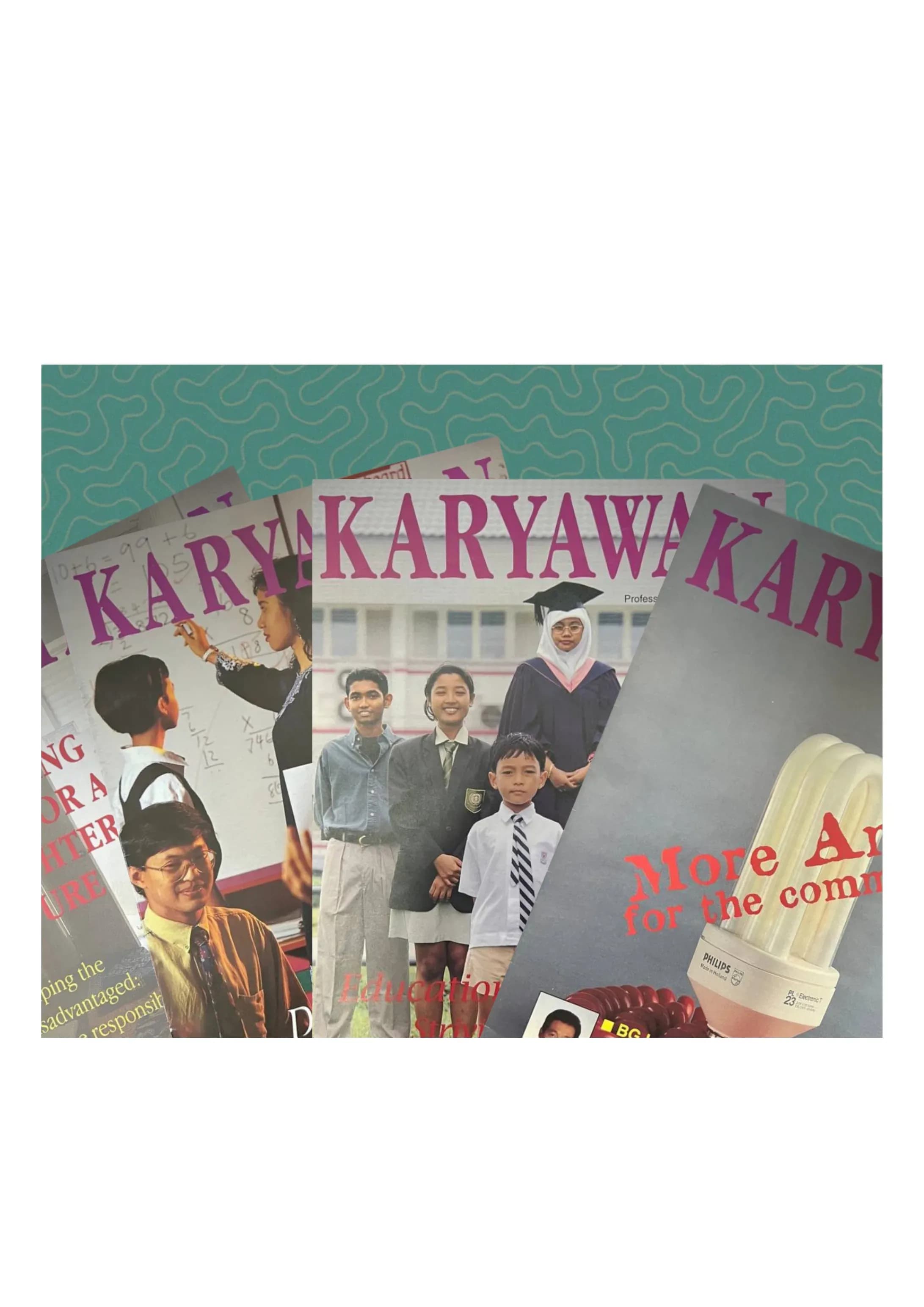
Since its establishment in 1994, Karyawan has served as a vital platform for intellectual and socio-political discourse within the Malay/Muslim community in Singapore. In its earlier days, the publication was first envisioned as a platform to address pressing issues surrounding the Malay/Muslim community in the 90s. Fast forward to today, it has expanded to encompass a wide range of themes, including cultural identity, Malay literature, media consumption, and more. Some might question: Why trace the evolution of Karyawan? Beyond the nostalgic physical copies of Karyawan currently sitting on my desk as I write this article, it is about observing how the topics and discourse have evolved over the decades, as well as identifying the recurring themes that have endured over the past three decades. In tracing the evolution, we uncover not just what has changed, but what continues to matter for our community. During a recent conversation with Karyawan pioneers, it became clear that these foundational themes were not only relevant in their time – they continue to resonate in today’s discourse. This article will be a learning journey of the different topics that were ventured over the decades, and to dissect what kinds of topics were the most prominent of the time.
Setting the Foundation of Discourse (1994-1999)
Karyawan was materialised during a pivotal time when AMP Singapore was stepping forward as an activist, addressing salient socio-economic challenges faced by the Malay/Muslim community. This was a time when concerns about the community’s socio-economic performance, especially in education and employment, were at the forefront of national attention1. The early issues of Karyawan laid the groundwork for meaningful discourse. It was filled with articles that urged for introspection, dialogue, and concrete solutions to close systemic gaps and to uplift the community. Education in particular was viewed as the cornerstone of economic mobility. Writers did not just lay out concerns in writing, they advocated for national roundtables and community-led discussions to design interventions that could build a strong foundation for the future mobility of the community. In my perspective, that era marked Karyawan as a platform to assert the urgency of addressing socioeconomic disparities that were happening in the 90s.
In relation to education, a notable article from this period was ‘Helping the Slow Learners’ by Dr Abdul Razak Chanbasha, published in the February 1996 issue. Dr Razak highlighted the challenges faced by children with learning difficulties, arguing that timely and adequate support at the primary school level was essential for their development. He proposed ways the community and educational institutions could rally together to support slow learners, not only through remedial academic programmes, but also by investing in emotional support systems and teacher training. His piece exemplified Karyawan’s early role as a catalyst for community-driven policy thinking and inclusive educational strategies. Similarly, the article ‘Making Space for Creativity’, an interview Claire Chiang, who was then serving as a Nominated Member of Parliament (NMP), published during the national push towards a 'Thinking School, Learning National’2. It challenged readers to rethink the definition of educational success. Claire Chiang shared her insights on how creativity could be nurtured within the education system. The article tackled questions around classroom culture, pedagogical practices, and systemic changes needed to cultivate curiosity and innovation. This was significant not only for its timeliness and relevance, but also for encouraging the community to expand its understanding of success in education; not only focusing on academic achievement but also including the development of holistic thinkers and adaptive learners.
Beyond education, other articles expanded the conversation to include leadership and the role of professionals in community development. In Adding Value to the Community, Jumari Naiyan explored the emergence of a growing class of Malay/Muslim professionals and raised salient questions about how AMP (and by extension, the wider community) was mobilising the Malay/Muslims for broader societal benefit. A question to conclude the article may look like this:
“What structures are in place to ensure that the expertise and passion of professionals translate into meaningful contributions to the community's progress?"
His follow-up piece, Karyawan Roundtable Discussion: Need for a Strong Foundation, reported on a gathering of community leaders and thinkers who assessed the community’s development and advocated for proactive, solutions-focused thinking. This roundtable was a defining feature of Karyawan’s mission from the start, signaling a shift from passive commentary to proactive agenda-setting. As I was reading through this era of Karyawan, it made me reflect on how our community has made great progress over the years. However, we continue to grapple with similar themes today, particularly in relation to education and income/employment. This continuity is evident in the January 2022 article by Yusof Sulaiman, 2020 Census - A Community’s Perspective, where he revisits these enduring concerns through the lens of the Singapore Census of Population 2020. Yusof Sulaiman offered a thoughtful and balanced reflection on the progress the Malay/Muslim community had made, especially in areas such as educational attainment, professional participation, and home ownership. At the same time, he remained clear-eyed about the persistent challenges that continued to shape the community’s trajectory—such as income disparities and underrepresentation in high-growth sectors. His article, much like the earlier pieces in Karyawan, called for sustained, collective effort to address these structural gaps.
Collectively, these articles underscored Karyawan’s role in laying the intellectual and strategic groundwork for the decades to follow. Fast forward 6 years later, Karyawan returned from its hiatus, with the November 2005 issue marking the beginning of a new era.
Broadening the Discourse (2005-2010)
As Singapore matured into a globalised, knowledge-based economy, so too did the scope of discourse in the publication. While early issues of Karyawan focused heavily on the community’s foundational challenges, this new phase marked a shift towards more complex themes that reflected the community’s evolving realities.
One of the most pressing themes during this period was the community’s preparedness for the sweeping changes brought about by globalisation. Articles like The Globalisation Wave: Challenges and Risks for the Malay/Muslim Community, by Saktiandi Supaat explored the uneven impacts of economic growth and structural change. It highlighted job displacement in vulnerable sectors and the widening gap between those who could adapt and those at risk of being left behind. Complementing this was another article titled ‘Globalisation and the Malay/Muslim Community: Time for a Closer Look Within’, by Mohd Nizam Ismail, which offered a critical reflection on the community’s vulnerabilities in navigating the new global era. These articles acted as a call for reflection, and they provided proposed strategies to enhance resilience and upward mobility, such as investing in higher education, technological literacy, and entrepreneurial ventures. This era of Karyawan also witnessed a growing number of articles exploring the religious identity of Malay/Muslim youths navigating modernity. As globalisation introduced new cultural influences and lifestyles, writers reflected on how young Muslims were negotiating faith and modern values in increasingly secular and pluralistic environments. These articles often grappled with the question of what it meant to remain rooted in Islamic principles while being part of a rapidly modernising and globalised society.
This period also saw Karyawan publish several notable series and thought pieces that stirred meaningful public dialogue. Essays on the implications of religious expression in secular spaces, critiques of policy frameworks, and reflections on national integration generated responses both within and outside the Malay/Muslim community. Contributors ranged from long-time activists to young professionals and academics, all bringing a mix of grounded experience and scholarly rigour. These contributions solidified Karyawan's reputation as more than a community newsletter—it became a serious intellectual journal that was not afraid to ask difficult questions or challenge prevailing assumptions.
The Start of Something New (2015-2025)
Stepping into yet another chapter, August 2015 marked the launch of Karyawan’s third era. As digital media reshaped the publication landscape, Karyawan adapted to stay current and connected with its audience. Our editor-in-chief (as claimed by the RIMA team), Winda Guntor, shared that earlier editions were often dense with jargon. In response, the publication underwent a rebrand, introducing a more accessible mix of serious community concerns alongside lighter cultural and social features.
This era saw the publication delve deeper into social themes such as gender dynamics, parenthood, and religious identity, often engaging with the tensions between tradition and modernity. Writers examined how changing family structures, shifting gender roles, and evolving notions of faith were shaping the lived experiences of the Malay/Muslim community.
Karyawan also responded to the digital turn, featuring articles that addressed technological advancements, digital literacy, and the societal implications of a fast-evolving media and work landscape. These pieces explored how members of the Malay/Muslim community—especially youths—adapted to emerging trends not only in education, but also in their daily lives and the shifting career landscape. A notable addition during this period was the inclusion of book reviews, which served not just as cultural commentaries but as vehicles for reflection. These reviews often drew parallels between the narratives or themes in the books and the lived realities of the Malay/Muslim community—offering lessons on resilience, moral complexity, and community-building.
At the same time, Karyawan became increasingly bold in its editorial direction, shining a light on taboo topics that had long been underexplored in the public sphere. Articles such as Living +ly: Persons Living with HIV among the Malay/Muslim Community and A Walk in the Red Light District: Women in an Unconventional Trade, by Nabilah Mohammad, exemplified the publication’s commitment to opening up space for difficult but necessary conversations. These pieces offered unflinching yet compassionate perspectives on lives lived at the margins, challenging readers to confront stigma and broaden their understanding of community care and inclusion.
This period also saw the rise of personality features—intimate profiles of Malay/Muslim individuals working overseas or breaking new ground in unexpected areas. Through these stories, Karyawan provided a more nuanced, human-centered lens on success, struggle, and self-discovery.
At length, it is clear that I cannot delve into all 49 issues Karyawan has published since 1994. There remains much more to explore, and the discussion could easily continue at length. Rather than summarising all the issues (a task far too prodigious for a single article!), this reflection is a self-curated journey through the shifting themes and styles of The Karyawan over time. The publications have been consistently engaging with pressing issues, especially the discussion of the progress, values and tradition within the Malay/Muslim community. As Karyawan moves into its next chapter, its challenges will be to honour its legacy while embracing innovation. In continuing to ask difficult questions and amplify diverse voices, Karyawan can (and shall) remain a vital space for reflection, critique and inspiration. Hence, for your reading pleasure over a cup of caffeine, the Karyawan team would like to invite you to our time machine — by simply navigating to this link to read past Karyawan articles!
1 Suratman, S. (2004). “Problematic Singapore Malays” - The making of a portrayal. Tokyo University of Foreign Studies (TUFS).
2 ‘Thinking Schools, Learning Nation’ has been the national vision of education since its inception in 1997
Qamar Jannah Fateen is currently a Research Analyst at the Centre for Research on Islamic and Malay Affairs (RIMA). She holds a master’s degree in international development practice, specialising in sustainable economy. Her current research interests include social inequality, cultural development and diaspora of Austronesians/Malays.
About the Author
Qamar Jannah Fateen is currently a Research Analyst at the Centre for Research on Islamic and Malay Affairs (RIMA). She holds a master's degree in international development practice, specialising in sustainable economy. Her current research interests include social inequality, cultural development and diaspora of Austronesians/Malays.