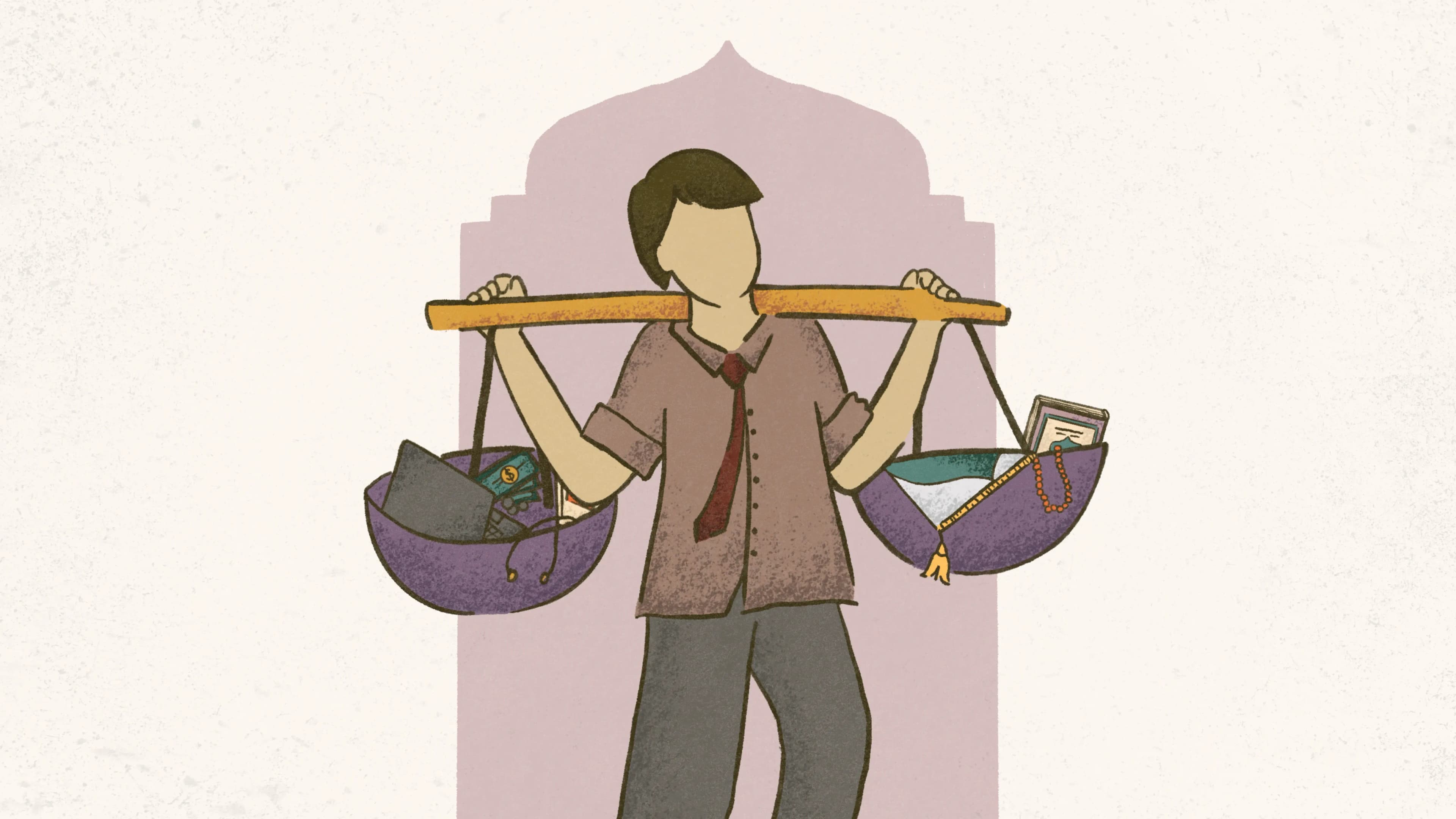
Religion remains an important part of many Singaporeans' lives. This is particularly true among Muslims – almost 60% of Muslims in Singapore consider religion to be very important in their overall sense of identity, compared to proportions of 32–38% for Christians, Catholics, and Hindus1. Among the faithful, for whom religion serves as an anchor in their identities, manifestations of religious beliefs naturally permeate all aspects of life, such as the spheres of community and family. As work occupies a significant portion of adult life – often taking up the largest share of waking hours as well – religious values naturally accompany many into their professional workplaces too.
However, despite the centrality of religion to personal identity and the substantial amount of time individuals often spend at work, there is surprisingly little research in Singapore that directly examines the relationship between religion and work. Understanding how faith shapes everyday experiences can be very insightful in assisting employers, policymakers, and other stakeholders navigate religious practices within the workplace, or even in gaining deeper perspectives into wider employment and economic patterns in the labour force. However, national data tends to examine patterns of work and employment along the demographic lines of race rather than religion, and any in-depth research on the influence of religion often hinges on the initiative of the religious community itself. One notable example is a 2017 study commissioned by Christian unity movement LoveSingapore that explored how Christians in Singapore viewed work satisfaction, career aspirations, workplace challenges, and work-life balance2.
A literature scan on religiosity studies reveals that similar questions have rarely been asked of Muslim Singaporeans. Yet it is clear that Islam is not absent from the world of work. Although its influence can be subtle, operating through values, aspirations, and everyday decisions rather than straightforward economic outcomes, it is a significant force permeating the choices of many individuals that should not be overlooked.
3.The symposium, Community-In-Review 2026, is an annual event organised by AMP Singapore and its subsidiary RIMA to explore pressing issues in the Malay/Muslim community. This year’s theme, Beyond First Jobs: Gender, Family, & Youth Social Mobility, explored the intersections of career and caregiving responsibilities.[]
This article synthesises existing discourse on Islam and work, and brings forth emerging findings from a study by the Centre for Research on Islamic and Malay Affairs (RIMA), to begin a conversation in studying the many ways religion can shape and influence how Muslim Singaporeans approach work.
Islam as a Hub
From a broader macro view, one visible sphere where religion and work can intersect is through the institutions and hubs of its communities. For one, a large number of Muslim organisations in Singapore serve functions that extend beyond religious affairs, invested in improving the holistic wellbeing of the community. Many provide career-related services such as roadshows and career fairs, acting as sources of support that can assist in career pathways. Some examples include AMPx initiatives by AMP Singapore or MENDAKI Professional Networks, both aimed at engaging Malay/Muslim professionals in the workforce.
For another, in a recent symposium by RIMA3, panel speaker Dr Shamsuri Juhari recommended that mosques can actually act as spaces where information can be translated into sources of social capital, helping individuals access opportunities that might otherwise be unavailable to them, either by a lack of access or information. Mosques are a familiar space for many to organically build relationships and can feel more comfortable than pre-planned one-time meetings. Bringing networks into places of worship also taps on the social trust between communities and moral authorities – as a recent IPS study noted, “Religious leaders and organisations, by virtue of their community reach and moral authority, can serve as critical partners in reinforcing positive norms“4. For instance, an initiative called “Working World, What They Don't Teach in School” by Maarof Mosque in 2022 sought to bring together graduates to learn more about past and future trends and challenges in the workforce and build peer circles5.
Islam as a Lens
Contemporary Muslim writers have increasingly argued that faith should be the primary angle with which Muslims approach work, instead of treating religious values as secondary to the monetary benefits of a job. Just last month, writer Khai Asyraf penned an article in Karyawan about how faith should be the “first lens” for Muslims in work matters. He posited that, Islamic concepts such as barakah (blessing) and tawakkal (trust in God) are absolutely necessary in discussions of success, beyond any quantitative, secular measurements like salaries or promotions6. Around the same time, speakers Abu Sofian Eunos and Mysara Alajru spoke in a podcast by RIMA7 on cultural conceptions of success, discussing amanah (responsibility) and khidmah (community service as an act of worship) as some central values deeply embedded in conceptions of work and success.
The growing popularity of discussions around “The Barakah Effect“, a term popularised by author Mohammed A Faris (2024) in his book of the same name, reflects this shift. The subtitle goes: “More with less.” Such writings argue that modern society and hustle culture have conditioned individuals to equate worth with career advancement and financial achievement, often at the expense of spiritual development and wellbeing. It urges Muslims to pursue excellence in their careers with Islamic-facing intentions. In the book, Faris drew on historical examples from the “Golden Era of the Islamic Civilisation”, where advancements were not motivated by pure ambition or hustle, but “because some of the greatest scholars, scientists and mathematicians of that time had sincere intentions to do what’s good for society and be God’s khalifah (vicegerent) on earth” (p. 164)8.
In this understanding, career success becomes meaningful when connected to a larger purpose, and only when Muslims put religious values and outcomes first as the lens with which to view and perceive career.
Islam as a Screen
Beyond the themes already examined, RIMA's study on Intergenerational Mobility within the Malay Community in Singapore9 revealed further insights into the overlap between religion and work, such as the extent to which religious affiliation influences access to career opportunities. One respondent shared how visible religious identities may affect access to particular environments and opportunities.
Once you have that tudung (Muslim headscarf), you know, it’s a bit difficult for you to also go in there [spaces with prohibited items or activities such as bars]. Because you also have to jaga nama (protect one’s reputation). So, for me, not wearing a tudung […] I can exist in different spheres (p. 54).
Other respondents highlighted broader social attitudes, hinting at a disconnect between how older and younger generations of Muslims interpret Islamic values in gender roles, and how this can sometimes affect discussions around leadership and authority in the workplace.
But society is also a difficult thing. Not everybody […] can accept the idea [of a woman as a leader] because, being in Islam, the khalifah (vicegerent) is supposed to be the male. […] The older generation would be sceptical if the woman lead[s] the mosque, even though we are talking about mosque management (p. 63).
These accounts suggest that Islam can also be perceived as a filter by which individual and societal interpretations of religious values allows or constrains access and opportunities.
Islam as a Compass
In the same RIMA study, another recurring theme was how Muslims perceived Islam as a foundational guide to the very first, baseline decision made in one’s career: the field or industry to pursue.
This was manifested in two ways. First, religion functioned as a moral compass, guiding people away from perceived “wrong” paths. When it came to their children’s careers, many respondents were very open to letting them choose their own paths, provided those choices did not conflict with religious principles. Many felt that career choices should, at the very least, avoid industries deemed haram (impermissible).
There are certain jobs that you shouldn’t be doing. […] If they want to be an air steward or air stewardess on airlines that serve liquor [...] I will not give my blessings, and I really hope that they will keep away from such jobs (p. 66).
Flight attendant! […] It’s the grey areas, like you serving alcoholic beverages and all that. And you don’t know what part of your income is halal or haram (permissible or prohibited) […] I rather my children be a better Muslim than working in non-halal [industries], having an income. The barakah (blessing) will not be there (p. 66).
The primary concern, found both in the survey and the interviews from the study, was not the specific profession itself but whether the work remained within the boundaries of the faith.
The other way in which religion functioned as a moral compass was guiding people towards “better” paths and into broader ideas of toyyib (good and wholesome) work. For some, occupational choices should be made with considerations beyond just the permissible; they should also be weighed in terms of their positive contributions to society.
Being a Muslim, the knowledge that you are given, you are supposed to put it to good use. Not only for yourself. You know, you have to contribute (p. 66).
It’s like berkat (blessing) lah, to work in such an industry, because I’m helping people (p. 66).
[My parents] always tell me, like, it’s okay to just give like, we don’t have to expect anything […] in the end, insyaAllah (God willing) we will be getting it back even better. So from then, that mindset has been with me since I was young. I think that also played a pivotal part in my decision for my future […] especially this line of work (p. 66).
The two functions of a compass – steering people away from certain paths and orienting them towards others – often complemented each other, but did not always operate simultaneously.
Islam as a Source of Contentment
Lastly, the RIMA study also explored how Islam instilled values of contentment, gratitude, and moderation, shaping participants’ orientations toward material life and personal aspiration. Rather than pursuing endless accumulation, respondents described career choices and aspirations that at the baseline, simply centred on having “enough”.
We cannot be greedy, like we have to be humble. We have to be appreciative of what we have […] A sufficient amount for you to get by, for you to save for the future that you don’t have to keep chasing for more in life. I think that’s the Islamic value that influences my personal aspirations for myself, and also for my children (p. 66).
This finding provides some personal depth to how Islam shapes a worldview. In addition (or perhaps as a prerequisite) to perceiving the world and its existing structures and systems through a faith-forward lens, Islam at the very beginning of one’s journey can provide an internal, bottomless source of contentment separate from achieving any specific goals or pursuits in life.
Conclusion
With the majority of Muslims in Singapore considering religion to be very important in their overall sense of identity, it comes as no surprise that Islam serves as an enduring, solid bedrock underneath all the everyday choices made by Muslims, across generations. As a respondent succinctly shared,
Whatever it is, jangan lupa agama (don’t forget religion) (p. 66).
As a whole, existing discourse hints at the many different ways in which religion touches the world of work – as a hub, a lens, a screen, a compass, or a source of contentment – without ever inherently propelling or constraining career success. Rather, religion provides a framework through which many Muslim Singaporeans make sense of work, evaluate opportunities, and decide what a meaningful career looks like for themselves.
Still, despite evidence that religion shapes how work is experienced among Muslim Singaporeans, the area remains under-researched, especially considering how individual interpretations may widely vary based on context and personal values. As RIMA's ongoing research into career readiness among Muslims continues, a clearer picture of the interplay between religion and work may emerge.
About the Author
Sabrina is a Senior Research Analyst at the Centre for Research on Islamic and Malay Affairs (RIMA). She holds a master's degree in Southeast Asian Studies and is interested in state-society relations and Islamic and Malay history.
7.The RIMA Podcast explores a variety of contemporary issues within the Malay/Muslim community by inviting academics and practitioners to discuss the areas at hand.[]
8.Faris, M. A. (2024). The Barakah Effect: More With Less. Claritas Books.[]
9.Miller, R., binte Hardy, S., & Liaquat, A. (2026). Intergenerational Mobility Within the Malay Community in Singapore. Centre for Research on Islamic and Malay Affairs (RIMA).[]