The Sensory Turn in Curating Southeast Asian Heritage | Karyawan
The Sensory Turn in Curating Southeast Asian Heritage
Yang Amat Mulia Pengiran Anak Hamlatul Arsy Mulia
30 Apr 2026
10 min read
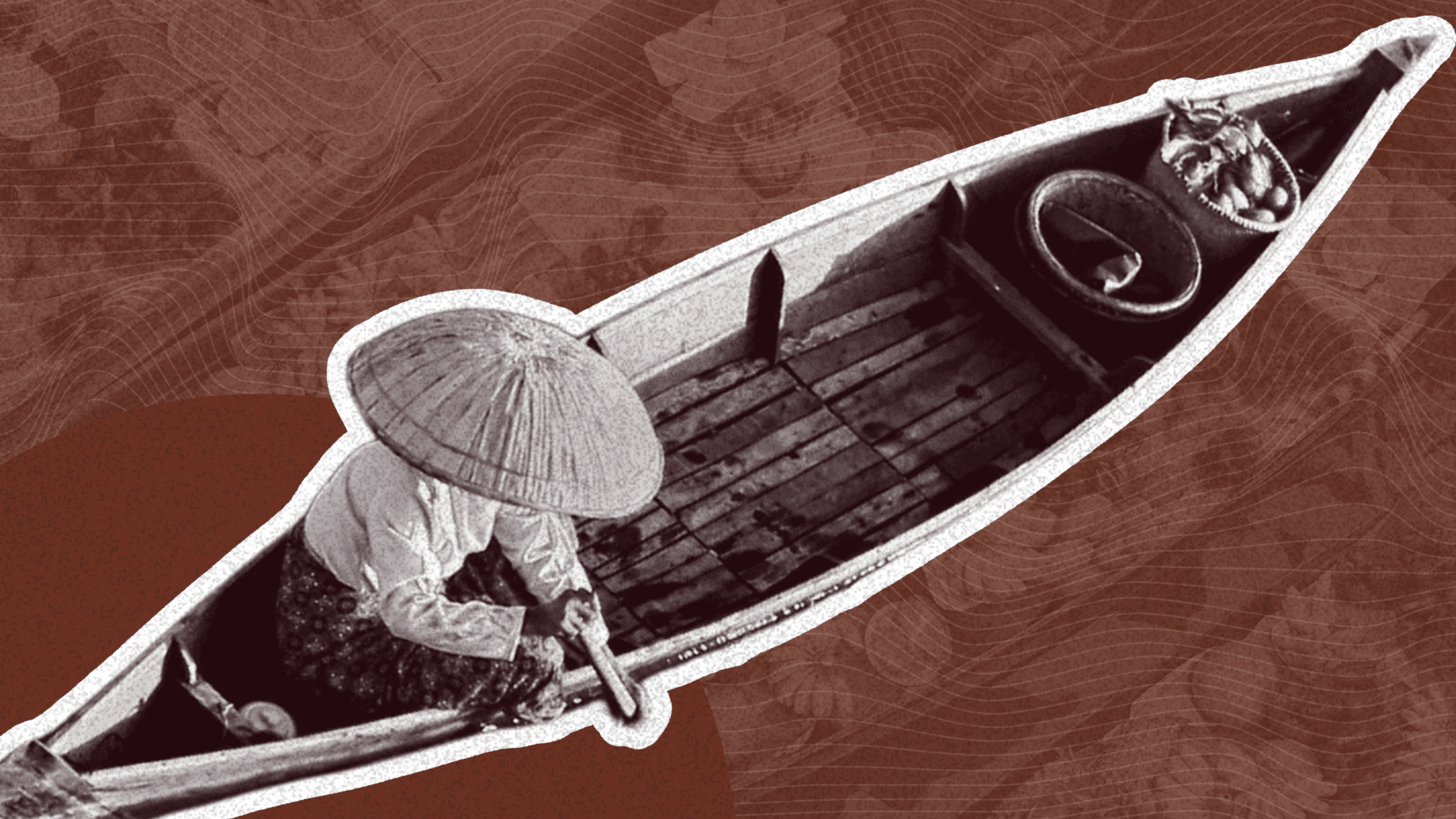
For five centuries, the Padian — the women traders of Brunei's historic water village, Kampong Ayer — paddled their boats through the water lanes at high tide, selling provisions door to door, their wide-brimmed seraung1 hats cutting a silhouette so familiar it was recorded by a sailor on Magellan's expedition in 1521. Antonio Pigafetta2 wrote simply: "When the tide rises, the women go in boats through the city selling provisions and necessities." He did not remark on it as exotic. It was just life.
Abdul Latif Haji Ibrahim3 linked their origins to the Shaer Awang Simaun4, a narrative poem in the Malay syair tradition, which credits Pateh Berbai5 with conceiving and naming the Padian — establishing the floating market so that a large population could be served efficiently and, should disputes arise, be easily dispersed. For centuries they were the circulatory system of Kampong Ayer: women exclusively, their boats laden with fish, vegetables, kuih (cakes), and cloth, numbering between 150 and 200 at their peak. So embedded were they in daily life that the Padian developed their own system of identification; coloured cloth tied to the knot of the seraung — to signal their presence to regular customers along the water lanes. They were the nodes of a living network, and their knowledge of people, of the particular rhythms of a community organised around water — was carried entirely into practice and relationship.
References
1.Large woven straw hat characteristic of the Padian, described by Abdul Latif Haji Ibrahim as measuring several feet across the brim, shaped like an inverted bowl, and worn as protection from sun and rain while trading on the Brunei River.[]
2. Pigafetta, A. (1521). In Bastin, J. & Winks, R. W. (Ed.). In Bastin, J & Winks, R. W. (Eds.), Malaysia: Selected Historical Readings (p. 41). Kuala Lumpur: Oxford University Press.[]
3.Haji Ibrahim A. L. (1970). Padian: Its Market and the Women Vendors. Brunei Museum Journal, 2(1).[]
4.A narrative poem in the Malay syair tradition
Their disappearance was gradual and institutional. The titian — raised wooden plank walkways built incrementally across Kampong Ayer through the mid-twentieth century, connecting the stilt houses and intended as improvements — made it impossible for small boats to navigate the water lanes. Permanent markets on land redirected trade. The knowledge the Padian carried was minimally archived because no institution decreed it worth preserving. By the time Abdul Latif was writing in 1970, it was difficult to find more than fifty Padian. Today they only survive in photographs, in paintings, and in the memories of the elderly.
But the Padian were never alone. From the wayang (puppet) stages of Central Java to the surau (prayer room) of the Malay Peninsula, from the longhouses of Borneo to the salt flats of Lombok — to be alive in Southeast Asia was to be fluent in a language without alphabet, expressed instead through sensation. This was how knowledge moved, so deeply embedded in daily life that to label it would have been as strange as naming the air.
Today, the Padian are gone. What replaced them was not nothing. What replaced them is precisely the problem. The real question this article asks is not how to recover the senses, but whether our institutions are finally prepared to stop proceeding as if they were never lost.
The turn that was never ours to make
The phrase "sensory turn" emerged from Western academic circles in the 1990s — a corrective, born of the belated recognition that the European humanities had spent two centuries reducing culture to text and image. Anthropologist Paul Stoller, in his study of the Songhay people of Niger, was among the first to name what he observed: that Western scholarship had systematically excluded the non-visual senses from serious inquiry, producing accounts of human culture that were not just incomplete but fundamentally distorted6. David Howes and Constance Classen at Concordia University went on to build the theoretical scaffolding of what would become sensory studies as a discipline. By 2006, the field of sensory studies had a journal, a manifesto, and a name7.
The project begins from a premise that does not survive the crossing — that the senses were absent and must be restored. In Southeast Asia, this assumption lands in the wrong direction entirely. When Stoller argued that Western scholarship had excluded the non-visual senses, he was diagnosing a failure of academic attention — the cultures being studied were always sensory; the problem was that the scholars writing about them were not. In Southeast Asia, the failure is different in kind. The senses were never absent from the culture. They were excluded from the institution — the museum, the heritage body, the curatorial framework — that claimed to represent it. These are not the same thing. One is a failure of scholarly perception. The other is a failure of institutional honesty. Collapsing the difference does a quiet violence to communities whose knowledge was never lost — only refused entry at the door.
The institution that could not hold us
The advent of the museum arrived as part of the same civilisational project that found the Padian unremarkable enough to note — classifying, labelling, arranging knowledge for the European eye. The keris (dagger), the songket (handwoven textile), and other sacred objects of the Malay archipelago were extracted from living practice and displayed. But the glass case was also a philosophical position; you may look, but you may not touch, hear, smell, or taste. You may not know these artifacts the way their makers knew it. Post-independence institutions inherited this grammar — climate-controlled galleries, bilingual labels. The smell of the pasar (market), the sound of the azan (call to prayer) between shophouses at dusk, the weight of handwoven cloth against the hands — these were left outside. They continued anyway, without institutional permission. The knowledge never abandoned the community. It abandoned the institution. That distinction is everything.
Reawakening and erasure
Today, Southeast Asia is living through its own kind of sensory turn — one that did not originate in the academy but in the streets and heritage festivals. It moves in two directions simultaneously.
On one side, something genuinely hopeful is taking shape. In Singapore, the National Heritage Board's annual Singapore Heritage Festival has brought traditional practices into public squares, inviting participation rather than passive observation. The National Museum of Singapore's Reunion senior programme has gone further — placing elderly practitioners at the centre of the curatorial process, treating lived memory as expertise. No institutional effort can fully capture knowledge that lives in the body, that moves between people through practice and repetition, that was never designed to be displayed. But these efforts are honest in a way the glass case never was — they begin from the right premise, that heritage lives in people, not objects. In heritage work, the premise is everything. Getting it right does not guarantee success. Getting it wrong makes success impossible.
The other side of the coin is quieter, more incremental, and harder to argue against because it arrives wearing the face of progress. The provision store gives way to a bubble tea franchise. The old coffee shop becomes a co-working space with a curated playlist and branded oat milk. The third space — the unselfconscious gathering place that belonged to no one and therefore to everyone — is absorbed into the market and reborn as a lifestyle destination. This pattern repeats across the region — in Penang's disappearing mamak tables, in the commercialised batik workshops of Yogyakarta, in the heritage shopfronts of Hanoi's Old Quarter that now sell the aesthetic of a culture to visitors who will never know its weight.
What replaces the third space is not silence. It is noise, brightness, and stimulation engineered for throughput rather than belonging. The batik print on a tote bag. The kopitiam tile as an Instagram backdrop. The heritage aesthetic without the heritage knowledge. More stimulation, less meaning. As damaging as the colonial glass case, just considerably more photogenic.
Proposals exist to bring the Padian back — the boats, the seraung hats, the floating market, staged for tourists. It is a generous impulse. But the Padian was not picturesque. She was functional, economically embedded, and socially indispensable — the node of a network so finely woven into daily life that it could not be lifted out of it without coming apart.
To dress someone in a seraung and send her out on the river for a heritage festival is not revival. It is mimicry. The silhouette is there; but the substance is not. What made the Padian irreplaceable was not the hat or the boat; but the five centuries of relationship among them — the knowledge of every household on every route, the credit extended, the debt remembered, the particular trust that forms only through repetition and time. That cannot be reconstructed in an afternoon. It cannot be staged at all.
What the Padian already knew
Southeast Asian heritage is already sensory and always was. The curatorial task is not innovation, but is fidelity. Not the fidelity of archives and conservation reports — the other kind. The kind that cannot be filed. Fidelity is not preservation. It is presence. And presence has always meant the same thing here: showing up every morning, reading the tide, and knowing which door to knock on first.
Four principles follow. None of them new. All are already practised by those who never needed an institution to name them.
The first is to reactivate practice rather than display it. The angklung8 is not an object to be exhibited. It is a discipline that exists only when people play it together. Curation that understands this does not merely preserve the instrument but sustains the ensemble. It funds and creates space for rehearsal, ensuring the knowledge keeps moving through living hands and listening ears.
The second is to design for encounter — not between visitors and objects, but between people. The elder who remembers. The craftsperson who still knows. The Padian knew every household on her route — who was celebrating, who was in mourning, who needed credit and who could wait. That knowledge lived in relationship and could only be continued, never curated. The institution's role is to create the conditions for that continuation — and then trust the living to carry it forward.
The third is to admit what the conventional museum has always refused. Smell, Sound, Touch, Discomfort. Not as atmosphere, but as evidence. The keris is not merely a decorative object. It carries histories of violence, hierarchy, and spiritual power that a glass case flattens into aesthetics. Alongside the senses must come the willingness to let heritage be difficult — to hold grief, exclusion, and contradiction without smoothing them into something easier to visit. A curation that removes difficulty has not preserved the culture but produced a souvenir of it.
The fourth is to allow slowness. The Padian moved with the tide. A batik artisan does not rush the wax. A mak andam (beautician) does not rush the preparation of the bride — the ritual unfolds across hours, sometimes days, because what is being transmitted is not only beauty but knowledge of gesture, threshold, and the meaning of the moment itself. To optimise it is to empty it. Institutions that cannot slow down enough to honour this are not preserving culture. They are processing it.
None of this requires a new building or a larger budget, only a different set of questions. Not how do we display this — but who still knows this, and how do we preserve and enable their practice? Whose knowledge are we serving — and are we serving it honestly?
The knowledge never vanished; it simply retreated from institutions that could not hold it, surviving in the communities that never stopped knowing. Sensory heritage was not absent from Southeast Asia but refused entry. And so, outside the gates, it carried on.
This is not nostalgia. The Padian will not return unchanged, but their knowledge endures. Our task is not to recover the senses, but to build institutions worthy of what never left.
About the Author
Pengiran Anak Hamlatul Arsy is a Bruneian–Indonesian artist, curator, and researcher based in Singapore. She is the founder of The Curious Playgrounds, an independent cultural lab and trans-disciplinary production network , where she leads ongoing inquiries including The Living Literature.
The Living Literature's curatorial projects attend to Southeast Asian specificities - and take the unspectacular seriously as material worth staging. Her practice explores how contemporary art can honour overlooked histories and amplify Southeast Asian knowledge systems. Working across exhibitions, animation, and community research, she translates rituals, foodways, and oral histories into multi-sensory experiences that foreground care, memory, and belonging while sustaining evolving cultural ecosystems.
5.Also known as Sultan Ahmad of Brunei, the brother of Awang Alak Betatar, who was the first Sultan of Brunei[]
6.Stoller, P. (1989). The Taste of Ethnographic Things: The Senses in Anthropology. Philadelphia: University of Pennsylvania Press[]
7. Bull, M. (2006). Introducing Sensory Studies. The Senses and Society, 1(1)[]
8. A traditional West Javanese musical instrument made of tuned bamboo tubes. Each instrument produces a single note, meaning the full melody can only be created collectively, with multiple players working together.[]