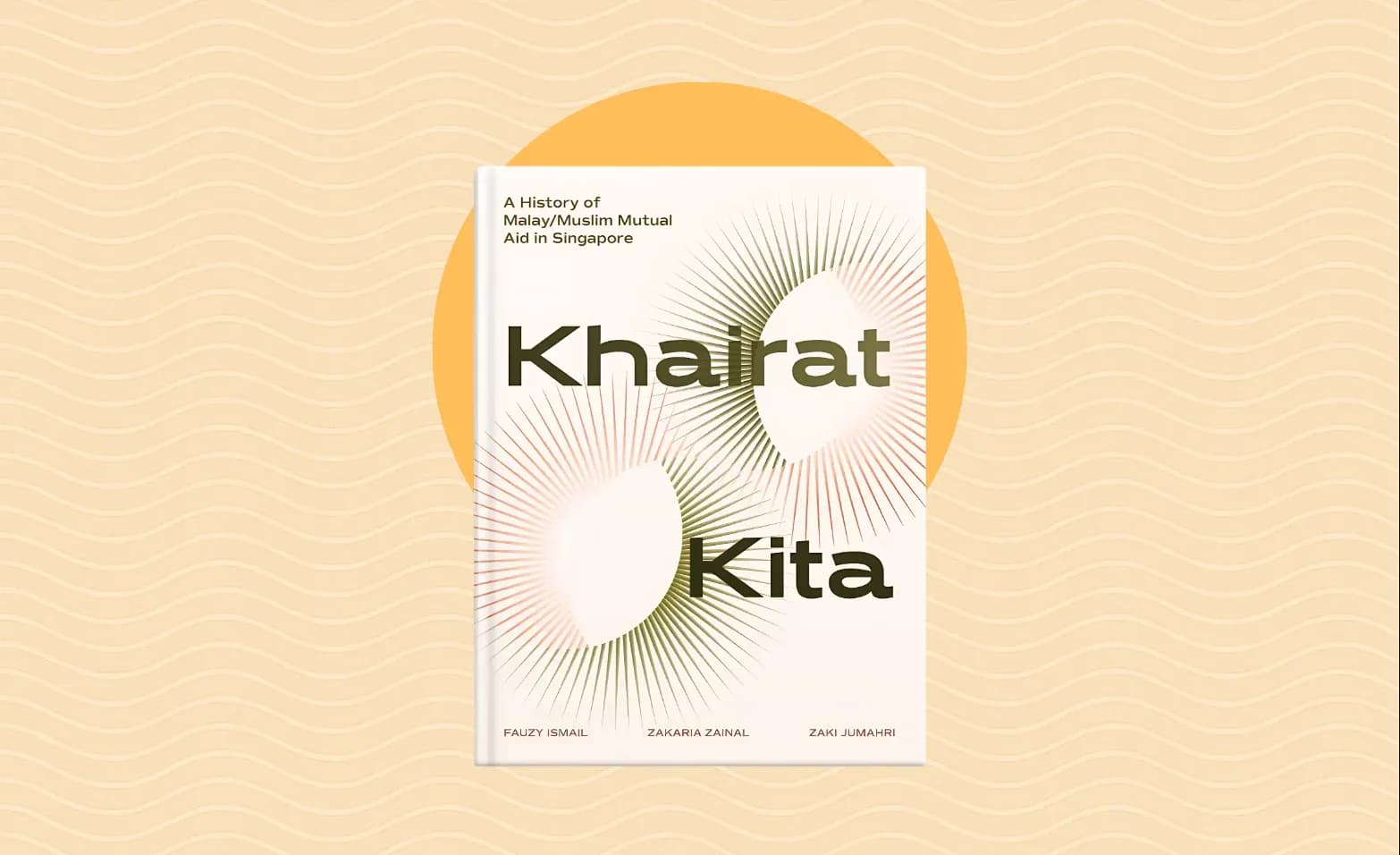
Khairat Kita (2022) is a collective work by Fauzy Ismail, Zakaria Zainal, and Zaki Jumahri, that documents the history and lived experiences of Malay/Muslim Mutual Benefit Organisations (MMBOs) in Singapore. Through a mix of oral histories, photographs, and personal reflections, the book sheds light on how these membership-based groups once formed the backbone of communal welfare and solidarity. More than a historical archive, it offers readers a window into the values of gotong-royong1and mutual aid that were once deeply embedded in Malay/Muslim life. Today, when few in the community recognise the role of MMBOs, the book brings a compelling forefront of a fading (but really important) tradition of self-help and collective care.
One of the strongest insights from Khairat Kita is how deeply rooted MMBOs were, since 1890s, in the values of gotong-royong and mutual aid. These organisations operated on membership fees and collective contributions, ensuring that when individuals in the community faced any hardships such as death, illness, or financial need, the rest of the community would step in to support. Although initially organised to fund funerals for those who could not afford it — with funeral services ranging from SGD 1,500 – 4,000 as of 20252 — priorities for MMBOs shifted in tandem with Singaporeans' increased spending power. This showed in instances where MMBOs providing bursaries to members' children. Within the same element of discussion, MMBOs also extended their involvement in cultural and religious activities. The book highlighted the social and cultural importance of leadership within MMBOs, which often overlapped with respected figures in the community – penghulu (chief of kampung)(religious leader)or other local leaders, who straddled multiples roles across organisations. These positions gave MMBO leaders direct influence, not only in practical welfare matters, but also in religious and cultural life. Namely, it was highlighted that as community members approached MMBOs for funeral funds, naturally, cultural knowledge of funeral rites and customs were also preserved and transmitted. This reveals that MMBOs were as much about maintaining religious and social norms as they were about financial aid.
Concurrently, the book does not shy away from the challenges and decline of these organisations. With ageing leadership, shrinking memberships, and the rise of state-led welfare systems, MMBOs have gradually lost their relevance. Once numbering 96 across Singapore, MMBOs have now dwindled to 22. The timeline presented in the book shows that their decline began in the 1980s, with numbers falling to 83 by 1985, and further down to 72 by 1989. Although efforts were made to adapt activities in order to attract and retain members (especially as more Malay/Muslim organisations have emerged in the 80s and 90s), the wave of de-registrations nevertheless persisted. This stark decline highlights the fragility of the tradition, and the challenges of sustaining it in today’s modern context. The book captures this decline in a bittersweet tone; combining written reflections with photographs of elderly members, archival stills, and conversations about the future. Though it acknowledges this sober reality, the book leaves open the possibility that the values of compassion and collective responsibility can be revived in new, innovative ways - in new forms and shaped by the technologies, challenges, and social conditions of our time. While non-profit and charity organisations exist to support the community, bureaucratic processes and structures can hinder the timely delivery of care. This is where mutual aid organisations play a vital role -- complementing this gap to provide immediate assistance when urgent needs arise. In this sense, we reckon that this book not only provides nostalgia, memory, but also raises a very important question: in acknowledging the important role of mutual aid organisations, how then can communal responsibility evolve in ways that remain relevant? As such, to better situate Khairat Kita in our own contexts and to better understand the practice of mutual aid today, we spoke to Hana (name have been changed to protect privacy) - who has been involved in the practice of mutual aid since 2020.
One of the things highlighted was the evolving structure of mutual aid organisations. The playing field is vastly different now that community is now found mostly on social media, where the reach is much wider in comparison to the finite communities that were served by MMBOs. In the past, MMBOs were organised to cater to their respective objectives such as occupation, ethnicity, or locality -- but today’s mutual aid efforts operate within much broader and more dispersed networks. As such, this has contributed to a more decentralised form of practice. Hana observed that after the dissolve of a central Telegram group which had acted as a unifying platform for mutual aid during the Covid-19 pandemic, the practice became more fragmented. This decentralised nature means that while there are shared references, there are no specific established strict rules. Hence, the way mutual aid is carried out largely depends on the individual, which also means that the values that people hold influence how they engage with mutual aid -- leading to diverse and personal approaches across the board.
While the beneficiaries she serve may not be catered to respective objectives as mentioned earlier, her Muslim identity still plays a huge part in her approach to mutual aid. For her in Islam, there is an emphasis on the responsibility that one has in giving back to society – if one is in better position than others, one should try to rebalance this disparity. This reflection on power dynamics is something that comes up a lot for Hana in thinking about mutual aid. Ultimately, charity is never about the giver, which is something that Islam teaches – this process of decentring the self should remind us that charity should always be in the name of God.
During our conversation, sustainability for the mutual aid cause was one of the concerns that was raised: When does mutual aid end? The mindset shift here, which makes mutual aid a radical form of care, at least in the Singaporean context – and where mutual aid is different from institutionalised help or organised charities – is the shift in the temporal dimension of care. For Hana, when she thinks about sustainability in mutual aid, it is inherently about long-term care. That is to say, understanding that the process of caring for each other in a community is not transactional, or merely another project that has an expiry date. As expounded by Hana:
I think that having to also [re]learn the fact that we can be there and support someone for the long term is important. It's not for our own pleasure or to feel good. It's not like, "Okay, I've given $100 in dispensable income, I've saved a life." It's not about that.
Due to this long-term nature of care, sustainability of mutual aid is then deeply impacted by having a collective. The mutual aid endeavour is only made easier when they know that other people are also doing it.
Another point that arose was since much of mutual aid today exists largely on social media, the potential for one practising mutual aid to buy into the logic of social media increases -- increased views, shares, and engagement equates to increased resources pooled. For many, the form of aid that we are used to is from organisations that operate only with a lot of substantiated evidence. This brings us to another shift in mindset: One should not need for people to prove that they are in such dire circumstances to receive care. But how does one create rapport and understanding with the people they are requesting for resources from, while still maintaining the beneficiary’s right to their dignity and confidentiality? It is so important to note that in Hana’s practice, she holds the agency to create the narrative about the beneficiary that is on the receiving end. For her, it is then a way of practising how she articulates herself and how she navigates her relationships with others.
The business of caring for others is never easy, but that does not mean that the endeavour isn’t worth it. After all, the price of community is inconvenience. Alternative forms of care such as mutual aid, or the existence of MMBOs, challenges us to rethink how we can take care of one another better. While the long-term sustainability of mutual aid in its many forms remains a big question, its sustained presence across generations and communities suggests that people will always find ways to show up for each other when systems fall short. Khairat Kita thenreads as both a tribute to the past and a call to action for the future. It honours the elders and organisations who built networks of care in times when the community had little else to fall back on, while also acknowledging the challenges these groups face in a rapidly changing society, with changing rules, act, laws and structures that come their way. As community bonds are neither static nor guaranteed, ways to care for one another would need to be adapted to new social realities, actively sustained by each generation, and reimagined in ways that remain meaningful to contemporary, modern life. As such, these mutual aid systems will not be perfect – as it undergoes through the weather of time and succumb to human error – but the beauty lies in how they don’t have to be. They only require people who are willing to act from a shared sense of humanity, and to embrace the discomfort and complexity of care; only then can we begin to understand what it really means to live in a truly supportive and connected society.
Nur Izzatie Adnan is currently a Research Analyst at the Centre of Research on Islamic and Malay Affairs (RIMA). She completed her undergraduate studies in Sociology at Nanyang Technological University, where she was able to cultivate her love for unpacking and diving deep into different cultural phenomena.
Qamar Jannah Fateen is currently a Research Analyst at the Centre for Research on Islamic and Malay Affairs (RIMA). She holds a master's degree in international development practice, specialising in sustainable economy. Her current research interests include social inequality, cultural development and diaspora of Austronesians/Malays.