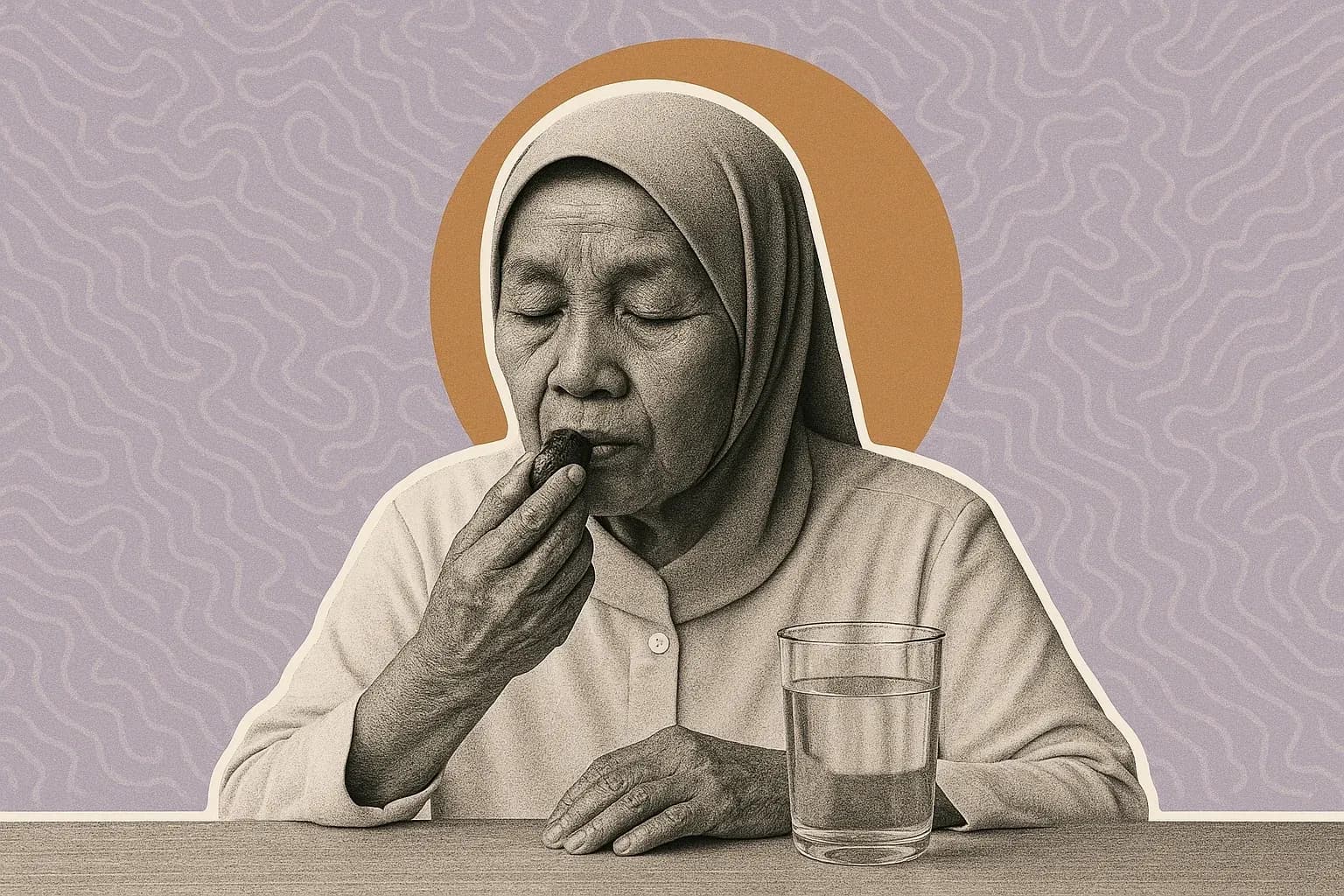
Ramadhan is a month that many Muslims look forward to for various reasons – the sense of community from terawih1prayers, having iftar2 at the mosque, or even from the annual Ramadhan bazaars with its large assortment of food sold. There is just something about the month that feels different from other months, that seems to be contributed largely in part by this collective heightened spirituality of the community.
Emile Durkheim coined this experience collective effervescence, which is the feeling of harmony and energy that is derived from participating in collective ritual action, which helps in fostering a sense of social cohesion.
The collective ritual action in this case is taken by many to be the ritual of fasting in Ramadhan, which is, of course, one of the main purposes of the month that has been prescribed to all Muslims. This clear commandment is stated in Surah Al-Baqarah, verse 183:
“O believers! Fasting is prescribed for you—as it was for those before you—so perhaps you will become mindful ˹of Allah˺.”
However, Ramadhan is not the same for everybody, and not everyone has the opportunity to fully immerse themselves in this collective effervescence for the entirety of the month. For Muslim women on their periods especially, there might be a feeling of missing out on good deeds and their rewards during the month because they are exempt from fasting and praying. These are rituals that make up the pillars of Islam that have been ordained to all able Muslims, and to not be able to carry them out might lead to a perceived sense of loss of connection with our creator. Of course, many understand that this is a form of mercy, and the beauty of Islam is that there is always divine knowledge behind whatever is decreed.
This Ramadhan, I managed to speak to a few individuals who were kind enough to share their feelings and experiences. who have faced or are facing difficulties fasting due to a lesser explored reason – their health. Here are their stories.
When asked about the struggles faced during Ramadhan, and their feelings towards them, Anna, late 30s, shares:
“The struggles that I face during Ramadhan are both physically and mentally, because to be honest Ramadhan is the hardest month of the year for me. [...] I do have some medical issues. I have low blood sugar, and an anemic condition, and I have (an autoimmune disorder) And because of these, the biggest challenge I usually face during fasting is brain fog. (...) It’s very dangerous because, for example, if I have to drive, the ground will suddenly tilt, and I get giddy because I will get disoriented. So driving is very dangerous and taking public transport is worse because I may fall over.”
There is this sense of guilt that is present when one is unable to fully observe the fast, which is followed by an elaboration of some form of ‘compensation’ carried out. It is interesting to note that these compensations are not always 1-to-1. In Islam, if one misses a fast, they would typically replace it with fasting on another separate day when they are able to. However, the ongoing health concerns of my interviewees necessitates that they compensate in other ways instead, which sees them trying their best to do more to benefit those outside of themselves.
On top of cooking meals for infaq3 to the mosques, Sarah, late 50s, shared:
“[I feel] really bersalah (guilty). So every year I pay fidyah4.”
Anna:
"It affects my sense of self-worth – am I worthy enough for the love of God? Am I worthy enough to celebrate Syawal? Because it feels like I haven’t put in enough work during Ramadhan to deserve Syawal and due to that, my Syawal celebrations are quite minimal. Because I just don’t feel like I deserve to celebrate it. [...]
[But] I try my best. I know I can pay back, and I try my best to pay back – but it’s a struggle. Probably just to kind of just feel a little bit better – during Ramadhan itself, I make a lot of donations. I know that if you’re unable to fast and you’re unable to pay it back, then you can donate a meal. So, every Ramadhan, I donate many meals to whichever non-profit orgsanisations out there that provide meals. It’s pretty good now, because there are many platforms out there online, where it’s not only for feeding needy individuals in this country, but you can also purchase these meals to feed needy individuals around the world, especially in conflict and war-torn areas. That’s what I do every Ramadhan, making sure to purchase as many meals as I can afford, just to feel a little bit better about myself."
Natasha, early 40s, who experiences Systemic Lupus Erythematosus (SLE), and a high-risk pregnancy a few years back, observes that the guilt she feels is more nuanced, and that it stems from her role as a mother vis-a-vis her kids. She says:
“Even though you don’t fast, you don’t want to eat. Maybe it’s guilt over [the fact that] you can’t fast, so you [don’t want to eat], but you also don’t want to eat in front of your children. You want to [have the feeling of] “one for all, all for one”. You know they’re hungry, they’re tired, then you also feel that it’s not right if they’re fasting and you’re not.”
Natasha also notes the mental preparation that she did before the fasting month when she was pregnant and going through SLE, expecting how she might not be able to perform certain Ramadhan rituals:
“Even though you’re mentally prepared, when you are in the midst of everybody else fasting, and you see everybody else being able to perform their ibadah (worship) as per normal, you will still feel a slight pinch.
But I think because you’ve gone through it before, you learn to redha (accept). It’s okay. You know because, you can still perform the lighter things, other forms of ibadah even though you can’t fast.”
However, despite feeling these, the individuals whom I interviewed noted that even though they were disheartenedthat they could not fulfil some aspects of the faith, they consoled themselves with reminders on how these afflictions is part of qada’ and qadr (divine decree), and that it is not a punishment in any way. There was an understanding that it is part and parcel of the trials of being human. As such, how did they strengthen their own spiritual practice despite being unable to fast?
Sarah:
“When I cook I zikr5, and I listen to surah6. I will follow the surah.”
Natasha echoes this sentiment as well:
“Unless it’s menstruation, you can still read the qur’an, you can still participate in classes, you can do your zikr. Apart from fasting, you’re not shortchanged in any way. Other than that, I’ll watch online classes, and the only thing I can do on my end is to zikr.”
She also shares a more communal approach, to still feel the collective effervescence of Ramadhan:
“For families, emotional support plays a big part, to give encouragement. And maybe to participate in deeds and activities that don’t require fasting, and you know you can reap the rewards together, like maybe doing volunteer work, or watching classes together. As a family, you can still embrace Ramadhan together in the same spirit.”
Anna shares a more reflective approach:
“It’s a month of self-reflection. Maybe during the day if you’re too hungry to do it, it can be a little harder. But at night, before/after your terawih prayers, it’s actually very nice to just sit down in solitary, and have a conversation with yourself, and just reflect on yourself - Reflect on your behaviour over the past years and have a conversation with yourself on how you can improve as a person, and strengthen yourself spiritually, mentally, emotionally.”
Our conversations also touched on community perceptions of individuals who are unable to fast, which revealed diverse viewpoints. Despite this, there was a collective conclusion that there were certain mores than the non-fasting individual should adhere to in order to respect the month.
Natasha muses:
“I think the community also expects people who can’t fast to also try to be respectful of the month – to not openly eat outside. Unless you’re on the hospital bed lah, then you need to eat. But generally, I think the community is [understanding], especially if it's because of health reasons. As long as the person who is not able to fast exercises discretion and adab (etiquette) of respecting the month.”
Anna brings up an interesting point on the visibility of illnesses that gives someone the ‘credentials’ to not be able to fast, thus escaping judgment. She raises the fact that there exists a somewhat performative aspect of an illness – that one has to look sick in order to be believed. However, she stresses that having to exaggerate the symptoms makes it not genuine.
“There’s a lot of pressure to just try harder to fast, even if you’re unwell. If you view someone as visibly unwell, like e.g. a frail and sickly elderly, you don’t judge them as hard because you can see their health is not at an optimum. But for someone like me who’s not particularly old, and on the outside I look healthy, [I feel this pressure].”
This pressure and thinking were corroborated by Sarah, who asserted:
“Unless you are lying in the hospital bed, if you can still work – people say you need to try to fast.”
Other times, the pressure seems to be self-imposed, as individuals would have had certain expectations for themselves and what they can achieve during the holy month where there are many opportunities to reap countless rewards. Natasha explains that the pressure may come from the fact that it is the holy month of Ramadhan, where she usually sets goals on what she would want to achieve for the month in order to try to reap as many rewards as she can. This leads her to try to do more than the usual.
Anna laments:
“There’s this stigma over trying your best. And this is where I kind of judge myself too. If halfway through the day I’m feeling so disoriented, I stop fasting because I don’t want any harm to happen to myself. When I break the fast, I judge myself because I feel like I'm not trying hard enough. And I'm sure there are healthy individuals out there who will judge me for not trying hard enough.”
Given that it is not a norm for one to announce or openly declare that they are unable to fast, many who might be facing this issue might be internally conflicted and feel that they are alone in this struggle. Raising awareness to create more understanding and empathy is thus important, so that these segments of the community feel destigmatised. Ending off our conversation, I asked my interviewees to share some final words for those who might struggle with fasting.
Sarah coolly advises:
“Take it easy, if you can’t, don’t do. If you can, just do it. Islam is very simple.”
Natasha reminds us:
“I’d say that Allah’s blessings are vast. His rewards are vast, and He sees our efforts, our struggles, and our intentions. Even on normal days, even if it’s not Ramadhan, if we set intention to do something, we are already rewarded for it, even if we don’t get to perform it. So don’t put yourself down, because there are other things you can do also to reap the benefits and rewards. Importantly also, Islam tells us to not do things that bring harm to us. Prioritise our health, we can always make up for it along the way.”
Ramadhan might be over, but the spirit of it lives on in the way we live our lives beyond the month. Thank you to the interviewees who have graciously made time and space to share their experiences and feelings on their struggles while fasting. May we all find strength and peace in our own ways
Nur Izzatie Adnan is currently a Research Analyst at the Centre of Research on Islamic and Malay Affairs (RIMA). She completed her undergraduate studies in Sociology at Nanyang Technological University, where she was able to cultivate her love for unpacking and diving deep into different cultural phenomena.