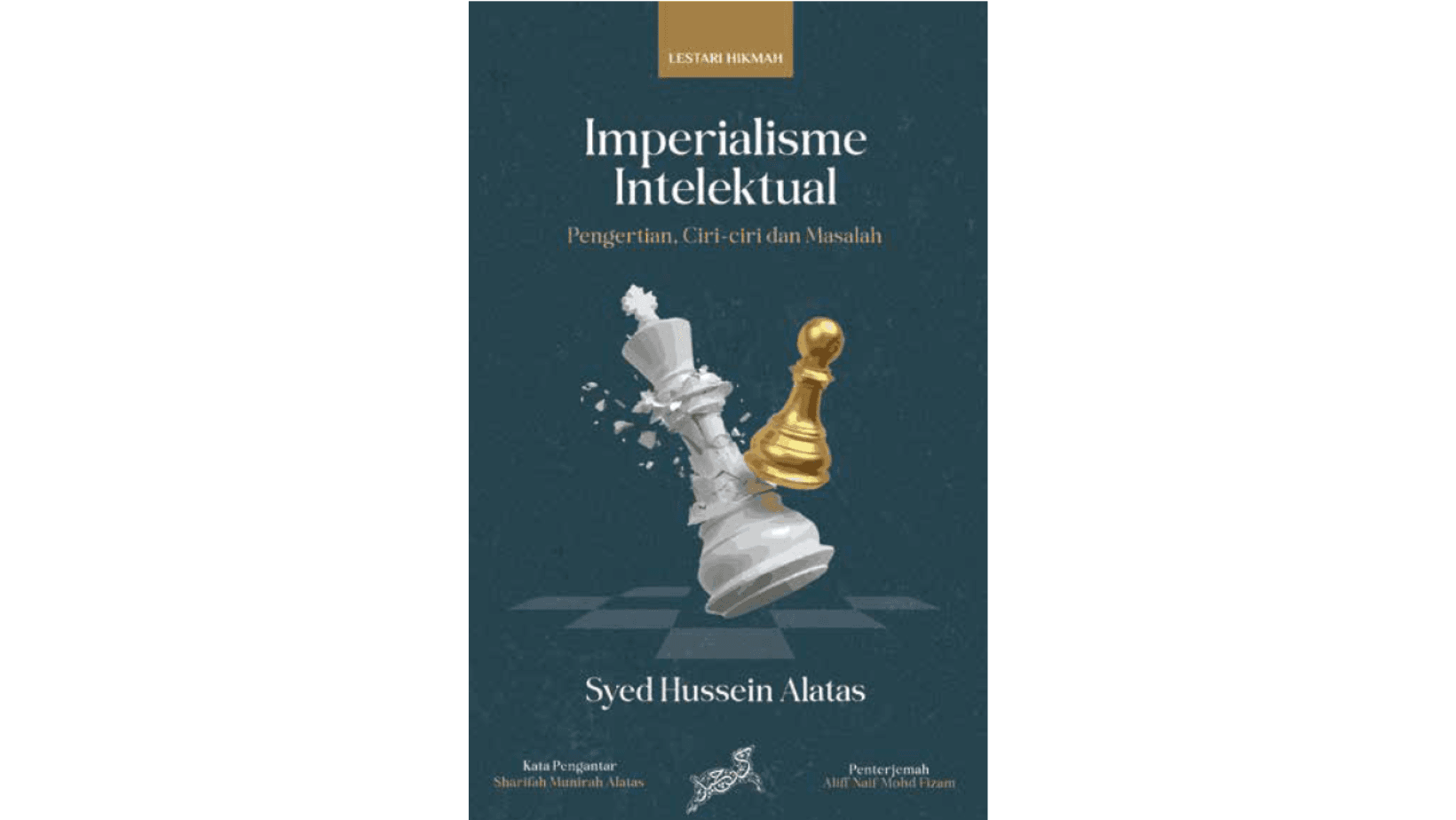
Book Review: Imperialisme Intelektual by Syed Hussein Alatas | Karyawan
Book Review: Imperialisme Intelektual by Syed Hussein Alatas
Haziqah Binte Rafiee
27 Jan 2025
11 min read
Imperialisme Intelektual written by Professor Syed Hussein Alatas is a profound piece of text which highlights the dangers of intellectual imperialism that one unknowingly adopts in their pursuit of knowledge. This book was written with the purpose of criticising the phenomenon of intellectual imperialism and highlighting its implications. First published in 2000, the book dissects the definition, traits and problems associated with intellectual imperialism. Within the context of Southeast Asia, the book also provides insights into the relationship or parallels drawn between political imperialism (involving the control of Southeast Asia by the West) and intellectual imperialism.
This review seeks to explore the definition, characteristics of the phenomenon of intellectual imperialism along with the problems that arise from it, strengths and limitations of Imperialisme Intelektual and its relevance to the Malay community in Singapore. Alatas’ work resonates deeply with the Department of Malay Studies in Singapore, with it being one of the alternative discourses created on Orientalism as part of the department’s tradition1. Similarly, Professor Farid Alatas from the department publishes articles revolving around academic dependency, intellectual decolonisation and the tradition of autonomous knowledge, thus proving how the discourse of academic imperialism is deeply rooted in the department.
Definition of Imperialisme Intelektual
In the introduction to the theory of intellectual imperialism in his article on academic dependency, Alatas includes that the phenomenon was defined by Johan Galtung as “that process whereby the centre of gravity for the acquisition of knowledge about the nation is located outside the nation itself”.
References
1.Alatas, S. F. (2018). “Silencing as Method”: Leaving Malay Studies Out. In Department of Malay Studies, National University of Singapore, Department of Malay Studies, National University of Singapore [Report].https://fass.nus.edu.sg/mls/wp-content/uploads/sites/13/2020/07/Alatas.SilencingasMethod-2-4-13795-Final1.pdf/[]
2.Alatas, S. F. (2022). Political Economies of Knowledge Production: On and Around Academic Dependency. Journal of Historical Sociology, 35(1), 14–23. https://doi.org/10.1111/johs.12362/[]
2
Characteristics of Imperialisme Intelektual
Imperialisme Intelektual is structured around the six characteristics of intellectual imperialism and the two problems perpetuated from it. Alatas identifies the six characteristics as:
Exploitation: colonial powers exploit the intellect of the colonised community; data or knowledge is collected or gained by foreign scholars then processed and transcribed into books or articles back in their home country (in other words, in the country of the coloniser)
Guidance: there are certain guidelines that the people from less developed countries have to follow, and are organised into the goals set by the colonising powers
Compliance: the dominant power expects the subjugated people to comply to certain aspects of its life, organisation and regulations
Secondary role: the subjugated people will not be given priority but rather play a secondary role in the control of international publications and in international conferences for example, with the excuse that it is ‘expensive’ to involve them in creative research
Rationalisation of the civilising mission: there are discussions on developing science in less developed countries according to the model being set by the dominant powers
Imperialist rulers/governors: those who govern colonised nations are of lower standards than those in their home country but are still looked upon in less developed countries for they gain knowledge in the aforementioned country and eventually act as experts in the field.
Alatas too, identified two problems that arise from intellectual imperialism:
Academic dependency: The methodologies used by scholars in less developed countries are just mere rituals, without any innovation made on their part for they imitate the topics researched thus limiting their audience with the publication of repetitive papers or journals revolving around the same topics repeatedly. This is seen as intellectual servitude and dependency. As for intellectual bondage, one would believe a certain stereotype without any research done on their part, thus restricting their intellect. Imitation comes in the form of writing and the choice of topic, making one estranged from their own intellectual traditions and experiencing the lack of interest and confidence in the past. This, therefore, leads them to perceive that there is no value in learning from Asian countries.
Intellectual comprador and the need for a separation: Local scholars are deemed as ‘traitors’ for they are paid to provide data to foreign scholars, who would then process and publish the aforementioned data in a form unrecognisable to the ‘traitor’, who, in turn, neither has any idea of the presence of the end product or get involved in the writing or publishing process; Alatas provides examples which highlight the main idea of one’s own country’s history being seen and written from a different lens. This, however, is not seen in Western countries as a Japanese or Indian will never be seen paying an American scholar to provide them with data which they would then transcribe into an end product distributed in Japan or India respectively. A notable example given by Alatas is the fact that Americans write their own history while Southeast Asians do not.
Alatas’ analysis spans several chapters, each focusing on specific themes:
The parallels between political imperialism and intellectual imperialism: The six characteristics of intellectual imperialism are linked and related to political imperialism.
The two problems that arise from intellectual imperialism: (a) intellectual servitude and dependency, bondage and imitation and (b) intellectual comprador and the need for separation
The continuity of intellectual imperialism: intellectual imperialism is not a new phenomenon but rather one perpetuated by the imperialistic practices adapted to the modern age
Intellectual imperialism and the captive mind: The captive mind is a product of the mind that seeks knowledge from institutions that breed its students to imitate others and are controlled by the Western way of thinking, hence resulting in a non-creative mind equipped with the inability to produce an original problem. The intellectual dependency on present-day stereotypes and the inability to separate the specific course of things from the general is also a characteristic of a captive mind. Other forms of the captive mind include: seeing things in fractions, being alienated from the bigger problems of society and separated from his own intellectual goals, ignorance towards its own captive state of mind, incapability to be examined quantitatively but rather in an empirical way and last but not least – it is the product of the dominance of the Western powers over the entire world. In this chapter, Alatas also provides salient examples that highlight the importance (for the colonial powers) of academic imperialism as a force that moulds and shapes peoples’ way of thinking according to the imperialists.
Intellectual emancipation: one has to free their mind from the shackles of intellectual imperialism to exponentially develop the tradition of creative and free social sciences in a developing nation.
There’s an overarching theme of historical journals and articles at the heart of intellectual imperialism. Alatas effectively conveys the peculiarity in allowing one’s mind to be dominated by the West, as it results in one's own history being rewritten and published by the West.
Strengths of Imperialisme Intelektual
Concrete solutions to solve the problem of the lack of drive or motivation that stems from intellectual imperialism are provided. Such solutions are listed as follows:
Being critical towards writers in general, including foreign writers
Shifting one’s attention to individual research topics
Not evaluating oneself according to foreign standards
Instil individuality and independence in oneself
Secondly, Imperialisme Intelektual has relevance to postcolonial studies. Alatas provides insightful and profound links to postcolonial studies. Last but not least, Alatas’ provides emphasis on intellectual dependency, where he emphasises the danger of intellectual imperialism on local scholars as it diminishes their creativity.
Limitations of Imperialisme Intelektual
The book, too, has its limitations. There is limited focus on non-Western intellectual traditions. The idea that the Western powers collect data from less developed countries, process the data into journals or publications in their home country then distribute and sell them in the respective country they made their research in is often repeated throughout the book. Additionally, the concept of individuals from less developed countries (who possess knowledge in their area of expertise) not having the knowledge to write essays or publish their own articles is repetitive. Focus on non-Western intellectual traditions such as methods non-Westerners use to do their findings or research are limited.
How the Potential of Imperialisme Intelektual can be Further Stretched
As someone deeply impressed by Professor Syed Hussein Alatas's extensive knowledge and masterful writing, I approach this with great respect for their scholarship. As a Gen Z currently undertaking pre-university studies, something I had hoped to see in Imperialisme Intelektual is solutions on how today’s youths can tackle the challenge of preserving or enriching one’s creativity in the pursuit of knowledge amidst the rise of technological advancements, but it is not to be fret upon since the book was published in the year 2000. Hence, I opine that the potential of Imperialisme Intelektual can be further stretched by inviting prominent scholarships (that have been influenced by Alatas’ School of Autonomous Knowledge) such as Professor Farid Alatas, Dr. Azhar Ibrahim, Noor Aisha and Shaharuddin Maaruf to write an excerpt or two at the back of Imperialisme Intelektual on how today’s seekers of knowledge can dismantle the captive mind and strengthen their creativity despite the rise in technological advancements such as AI. Such applications, namely ChatGPT, MetaAI and many more have provided users with shortcuts to problems, whether it be in academic fields or not. This is not to say that I completely discourage the use of AI in one’s studies since I implement it in my own learning, but rather, I believe that students of this age have the potential to outdo these artificial minds. AI provides lengthy paragraphs rich in vocabulary when one seeks for it to write an essay for them, thus setting a ‘standard’ to the user, leading them to think that their own work can only be deemed good when aligned with the standards set by AI. Alatas emphasises in Imperialisme Intelektual that a written piece of work is good, regardless of whether it is published in the West or not. In a similar vein, one should not heavily rely on the use of AI, because their work has its own uniqueness and does not need to conform to the standards set by AI. However, with the acceleration of the pace of life, AI has been central in our lives such that its use is inescapable. Hence, having the input of the aforementioned scholars could provide valuable insights on how youths can prevent their minds from being overcome by AI and discuss the problems and ethical aspects of the use of AI as well as the importance of maintaining intellectual integrity.
Relevance to the Malay Community in Singapore
Imperialisme Intelektual is relevant to the Malay community in Singapore as the phenomenon impacts cultural and language preservation. The choice of English as the lingua franca relegated Malay to a secondary position such that the Malay language has limited prominence in public life (despite it being the national language of Singapore), impacting cultural identity and self-esteem within the community. In addition to that, Alatas’ critique further proves the need for the Malay community in Singapore to reclaim their intellectual and cultural agency, by promoting Malay studies and fostering a deeper appreciation for the language among Malay youths in Singapore and appreciation for Malay contributions to Singapore’s history and development. Malay scholars, writers and educators should be given support to ensure that the community’s perspectives are represented and considered in national and academic discourses, thus challenging intellectual imperialism.
My personal reflections on Imperialism Intelektual
During my immersion trip in Sarawak as part of my Malay Language Elective Programme at the Pre-University Level (MLEP-JC), I was exposed to the culture, language and literature of the different ethnic groups in Sarawak – Iban, Melanau, Orang Ulu, Bidayuh, etc. On one of the nights, our teachers debriefed us, relating the activities for the day to the concept of ‘the captive mind’, and the thought of Alatas’ ideas in Imperialisme Intelektual came to mind. It was beautiful to see the pride the different ethnic groups had of their identity, and how their respective languages are still entrenched in their day-to-day lives – an example would be the Berita Iban segment on the TV Sarawak channel, i.e. news documented and relayed in the Iban language. Our teachers taught us that this was only possible because they had freed themselves from the captive mind, thus enabling them to preserve their cultures, language and identities. This, therefore, serves as a reminder that we, as Malays, should free ourselves from the captive mind, in order to truly preserve our culture, language and literature, for it to remain deeply rooted in the lives of the generations to come.
Conclusion
In conclusion, Imperialisme Intelektual by Professor Syed Hussein Alatas is an essential contribution to understanding the pervasive issue of intellectual imperialism, particularly in the postcolonial Southeast Asian context. By dissecting its characteristics, implications, and continuity, Alatas not only critiques the dominant paradigm but also offers actionable solutions to empower local scholars and resist the pervasive influence of Western-centric intellectual traditions. It is a compelling call for intellectual liberation, urging scholars and communities to reclaim their agency, celebrate their heritage, and chart an independent course in the global landscape of knowledge and culture.
About the Author
Haziqah Binte Rafiee, a Pre-University 2 student at Raffles Institution, is an active member of the Malay Language Elective Programme and Malay Cultural Society. She celebrates her culture through writing and debate, including her teams' 2024 Bahas 4PM victory. Haziqah also writes poetry with the RI Writers' Guild and shares her work through MudaSG and her Substack.